

Pikesville Security Guard Injury Attorney
Security work looks different from the outside than it feels from the inside. You are stationed at a hospital entrance at 2 a.m., managing an agitated patient. You are patrolling a commercial property in Pikesville when a situation escalates without warning. You are working crowd control at a venue off Reisterstown Road when someone gets physical. The job carries real physical risk, and when that risk materializes into an injury, the path to compensation is rarely straightforward. A Pikesville security guard injury attorney from Berman | Sobin | Gross LLP can help you understand what you are owed and pursue it through the right channels.
Why Security Guard Injuries Raise Complicated Workers’ Compensation Questions
Security guards in the Pikesville area work for an unusually wide range of employers. Some work directly for a hospital, school district, retail chain, or property management company. Others are employed by a third-party security contractor who then places them at a client’s site. That staffing arrangement, while common in this industry, creates immediate questions about which employer is on the hook when an injury happens, and which insurance carrier applies.
On top of that, the type of injuries security personnel sustain tend to be contested. Soft tissue injuries from physical altercations, repetitive stress from hours of standing or patrolling, hearing damage from prolonged exposure to alarms and radios, and psychological trauma after violent incidents are all real and documented, but they are also the categories that employers and insurers most frequently push back on. A back injury from restraining a combative visitor looks very different to a claims adjuster than it did to you in that moment.
Maryland’s workers’ compensation system covers most of these injuries, but getting that coverage confirmed and paid out is a different matter. Employers sometimes argue that an injury falls outside the scope of employment, particularly if it happened during a break, during a task the employer claims was unauthorized, or at a location where the employer disputes responsibility. These objections need to be answered with the right documentation, witness statements, and legal arguments, not just an insurance form.
The Specific Hazards Security Professionals Face at Pikesville-Area Work Sites
Pikesville sits in Baltimore County along the I-695 corridor and has a dense mix of healthcare facilities, retail centers, residential complexes, houses of worship, and schools, many of which employ security personnel year-round. The variety of these environments matters because the type of hazard shifts depending on the site.
Security guards at medical facilities along Reisterstown Road and near Sinai Hospital face a high rate of patient-related violence, a problem that has drawn increasing attention across Maryland’s healthcare sector. These are not random or unpredictable events in the aggregate; hospitals and healthcare employers often have documented histories of such incidents, and that documentation becomes relevant when establishing that an employer knew about a risk and failed to adequately address it.
Guards working retail properties and shopping centers in the area deal with a different set of hazards: physical confrontations with shoplifters or trespassers, slip-and-fall injuries on poorly maintained surfaces, and exposure to weather extremes when patrolling outdoor areas. Guards at residential communities and apartment complexes often work alone during overnight shifts, which increases the severity of what might happen if something goes wrong.
Understanding which hazard caused your injury matters not just medically but legally. It affects how the claim is framed, what records are most relevant, and whether there is a third-party liability claim available in addition to the workers’ compensation claim.
When Workers’ Compensation Is Not the Only Option
Workers’ compensation is the starting point for most injured security workers in Maryland, and it exists specifically to provide wage replacement and medical coverage without requiring you to prove your employer was negligent. But it is not always the only avenue available.
If your injury involved negligence by a party other than your direct employer, you may have a separate civil claim. That could apply if you were injured due to a hazardous condition at a client’s property that the property owner failed to fix, if a third party assaulted you and there is a basis for holding someone else responsible, or if a piece of defective equipment contributed to your injury. These third-party claims can allow you to pursue damages that workers’ compensation does not cover, including compensation for pain and suffering and full lost wages rather than the two-thirds cap that applies under workers’ comp.
Berman | Sobin | Gross LLP handles both workers’ compensation and personal injury matters, which means we can look at your situation from both angles and help you understand whether a combined approach makes sense. Most injured workers never hear this analysis because the attorneys they consult only handle one type of case.
What Injured Security Workers in Maryland Are Entitled to Receive
Under Maryland workers’ compensation law, a covered injury entitles you to payment of all related medical treatment, temporary total or partial disability payments if you are unable to work or are working reduced hours or capacity, permanent partial or permanent total disability benefits if you have lasting impairment, and vocational rehabilitation if your injury prevents you from returning to your prior work.
That last benefit, vocational rehabilitation, is one that many injured workers do not know exists. Maryland courts, including in a case argued by attorneys at Berman | Sobin | Gross LLP, have confirmed that injured workers receiving service-connected disability benefits can still access vocational rehabilitation services. Whether that applies to your situation depends on the specifics of your case, but it is worth knowing the full scope of what the system offers.
The challenge is that each of these benefit categories has procedures, deadlines, and eligibility conditions attached to it. A medical treatment request can be denied by the employer’s insurance carrier and has to be challenged through an expedited process. A disability rating can be disputed by the employer’s medical expert, and the quality of that dispute response matters enormously to the final outcome.
Questions Injured Security Guards Ask About Their Claims
I was working for a security contractor, not the property owner. Who do I file a claim against?
Your workers’ compensation claim is filed against your direct employer, which in most cases is the security company that employs you, not the property where you were working. However, if the property owner’s negligence contributed to your injury, a separate civil claim against that property owner may also be available. These two claims can proceed at the same time.
My employer is saying my injury happened because of something I did wrong. Does that affect my claim?
Maryland’s workers’ compensation system is a no-fault system, meaning that ordinary employee negligence does not bar a claim. Unless your employer can show that you were engaged in serious and willful misconduct, being partially at fault for your own injury does not eliminate your right to benefits.
I was injured during a physical altercation at work. Does it matter who started it?
Generally, if the altercation arose out of your employment duties and happened in the course of your work, the injury is covered. Security personnel are hired specifically because altercations may occur. An employer arguing that your injury should not be covered because of the circumstances of a confrontation you were stationed to handle is making a weak argument, but one that still needs a proper response.
Can I choose my own doctor for treatment?
Maryland law gives injured workers some rights regarding the choice of treating physician, though there are procedural requirements and the employer’s insurer will often try to direct you to their preferred providers. The medical opinions that come from those provider relationships can shape how your claim is valued, which is one reason having legal guidance early matters.
What if I have a pre-existing condition and my employer is using it to deny my claim?
A pre-existing condition does not bar a workers’ compensation claim if the work injury aggravated, worsened, or accelerated that condition. Maryland law recognizes aggravation claims. An employer’s attempt to use your medical history to deflect the claim entirely is a litigation position, not a legal rule, and it can be challenged.
How long do I have to file a workers’ compensation claim in Maryland?
Maryland generally requires that a workers’ compensation claim be filed within 60 days of the accidental injury or within 60 days of the disability or death in occupational disease cases, though the rules differ depending on the type of injury and circumstances. Waiting too long can result in losing the right to benefits entirely.
Do I need a lawyer if the employer’s insurer seems willing to pay?
An insurer’s initial cooperation does not mean the claim will be valued accurately or that all available benefits will be offered. Accepting a settlement without legal review can close out rights to future medical treatment or permanent disability benefits that may not be apparent yet. Getting an independent assessment of your claim before accepting anything costs you nothing and can protect you significantly.
Talk to Berman | Sobin | Gross LLP About Your Security Guard Injury Claim
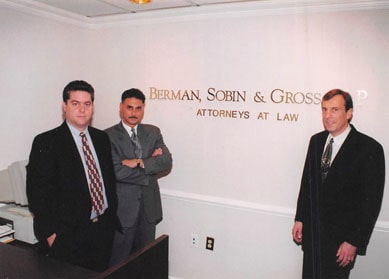
For 35 years, Berman | Sobin | Gross LLP has represented injured workers across Maryland, from Baltimore County to the Western Maryland corridor and everywhere between. We are the largest workers’ compensation law firm in Maryland representing injured workers, with offices in Lutherville, Baltimore, Gaithersburg, and Frederick. Security guards injured on the job in the Pikesville area can reach us for a confidential case analysis. There are no easy answers to workers’ compensation claims in this industry, and you should not have to figure out the right questions on your own. Contact Berman | Sobin | Gross LLP to speak with a Pikesville security guard injury lawyer about what your claim may be worth and what it takes to pursue it properly.