

Pikesville Landscaping Worker Injury Attorney
Landscaping work in and around Pikesville is physically demanding in ways that most office workers never think about. Crews operate heavy equipment on uneven terrain, handle pesticides and fertilizers, work through heat that regularly pushes into triple digits from June through August, and use power tools that can cause catastrophic injuries in an instant. When something goes wrong on a job site, the workers’ compensation system is supposed to step in. The reality is more complicated. If you were hurt doing landscaping work in the Pikesville area, a Pikesville landscaping worker injury attorney at Berman Sobin Gross LLP can help you understand what you are owed and pursue it.
The Specific Hazards That Put Pikesville Landscaping Workers in the Hospital
Landscaping injuries rarely fit neatly into a single category, which is part of what makes these claims difficult. A crew member operating a riding mower on a slope near one of Pikesville’s many residential properties may tip or get thrown. A worker trimming trees along Old Court Road or the wooded lots off Reisterstown Road can suffer serious lacerations, crush injuries, or fall trauma. Someone loading mulch or stone into a truck all day, season after season, may develop a disabling back condition that does not show up on an X-ray until the damage is already done.
Heat illness is another serious concern that does not always get recognized as a compensable workplace injury. Landscaping crews work outdoors during Maryland’s most brutal weather. Heat exhaustion and heat stroke can happen quickly and can leave lasting neurological damage. Maryland workers’ compensation covers heat-related illness when it arises out of and in the course of employment, but employers and their insurers sometimes push back on these claims.
Chemical exposure is also a real risk. Workers who regularly apply pesticides, herbicides, or fertilizers without adequate protective equipment can develop skin conditions, respiratory problems, or in serious cases, systemic illness tied to repeated chemical exposure. These occupational disease claims require specific documentation and often prompt heavier scrutiny from the employer’s insurer.
What Landscaping Workers Often Get Wrong About Their Claims
One of the most consistent problems in landscaping injury cases is worker classification. Many landscaping companies in Maryland treat their crews as independent contractors rather than employees. The distinction matters enormously. Workers classified as independent contractors are generally not covered by an employer’s workers’ compensation policy. But Maryland law looks at the actual nature of the working relationship, not just the label on a contract. Workers who are told when and where to show up, use the company’s equipment, and are directed by a supervisor on every job may well be employees under the law, regardless of how the employer has classified them.
If you were working as a “subcontractor” or “1099 worker” for a landscaping company when you were injured, do not assume you are automatically excluded from workers’ compensation. That determination deserves a real legal analysis.
Another common mistake is waiting to report the injury. Maryland law requires injured workers to notify their employer within 10 days of an injury or, in the case of an occupational disease, within 10 days of disablement. Missing that window can jeopardize a claim. Even workers who feel pressure not to report, or who worry about losing their jobs, have legal protections. Retaliation against an injured worker for filing a workers’ compensation claim is prohibited under Maryland law.
Third-Party Liability When Another Party Caused the Harm
Workers’ compensation is not always the only legal avenue available to an injured landscaping worker. When the injury was caused by someone other than the employer or a coworker, a separate civil claim may be possible alongside the workers’ comp case.
In Pikesville and the surrounding Baltimore County areas, landscaping crews frequently work on properties owned by third parties, alongside workers from other trades, or with equipment rented or manufactured by outside companies. If a defective piece of equipment caused the injury, the manufacturer may bear civil liability. If a property owner created an unreasonably dangerous condition, that could support a premises liability claim. If another driver struck a landscaping vehicle or worker on a roadway, a personal injury action may be available against that driver.
Pursuing a third-party claim does not eliminate workers’ compensation benefits, though the two claims interact in ways that require careful coordination. Berman Sobin Gross LLP handles both workers’ compensation and personal injury claims, which means the firm can evaluate both paths and help clients avoid the common pitfall of settling one case in a way that inadvertently damages the other.
Questions Landscaping Workers in the Pikesville Area Ask
My employer says I was an independent contractor. Does that mean I cannot file a workers’ comp claim?
Not necessarily. Maryland courts and the Workers’ Compensation Commission look at the economic reality of the working relationship, not just the label your employer used. If your employer controlled your schedule, provided your tools and equipment, and directed the details of your work, you may qualify as an employee regardless of what your contract says. This issue is worth examining before assuming a claim is off the table.
I developed back problems after years of lifting and hauling on landscaping jobs. Is that covered?
Occupational disease claims for cumulative physical conditions are recognized under Maryland workers’ compensation law. They are also harder to prove than acute injury claims, because insurers frequently argue that the condition is degenerative rather than work-related. Medical documentation linking your diagnosis to your job duties is critical. An attorney can help you build that connection and identify the right medical experts to support the claim.
My employer does not speak English and neither do I. Can I still file a claim?
Yes. Language is not a barrier to filing a workers’ compensation claim in Maryland. Berman Sobin Gross LLP has attorneys and staff members fluent in Spanish and is experienced working with clients across language differences. Every injured worker has the right to pursue benefits regardless of the language they speak.
What benefits am I entitled to if my landscaping injury prevents me from working?
Maryland workers’ compensation can provide payment for medical treatment, temporary total or partial disability benefits while you recover, permanent disability benefits if your injury results in lasting limitations, and vocational rehabilitation if you cannot return to the same work. The specific benefits depend on the nature and severity of your injury and how it affects your ability to earn wages.
My employer’s insurer denied my claim. What do I do?
A denial is not the end of the road. You have the right to contest a denial before the Maryland Workers’ Compensation Commission. Hearings are formal proceedings, and the insurer will have legal representation on its side. Having an attorney represent you at that stage matters. Berman Sobin Gross LLP has handled tens of thousands of hearings before the Commission and regularly takes cases into the courts when the administrative outcome does not reflect what the law requires.
Can I be fired for filing a workers’ compensation claim?
Maryland law prohibits employers from retaliating against workers who file workers’ compensation claims. If you were terminated, demoted, or otherwise penalized after reporting an injury or filing a claim, you may have a separate legal remedy beyond your workers’ comp case. Document everything that happens with your employment after you report the injury.
Does it matter whether my injury happened on a residential property or a commercial job site?
For purposes of the workers’ compensation claim itself, the type of property generally does not change your basic rights. What can change is whether any third-party liability exists. Commercial properties may have different ownership structures, and property owners have varying legal duties depending on the nature of the premises. Whether a third-party civil claim makes sense is a fact-specific analysis that an attorney should evaluate for your particular situation.
Talking to a Landscaping Injury Lawyer in the Pikesville Area
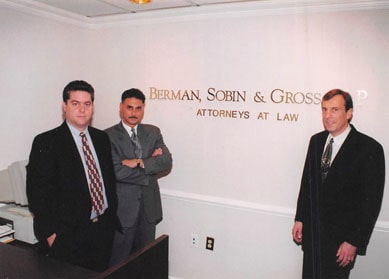
Berman Sobin Gross LLP has spent 35 years representing Maryland workers through the full range of workers’ compensation disputes, from straightforward claims to complex cases that required going beyond the Commission and into jury trials and appellate courts. The firm is the largest workers’ compensation law firm in Maryland representing injured workers, with offices across the state and attorneys who have literally written the definitive legal treatise on Maryland workers’ compensation. For a landscaping worker injured near Pikesville, that depth of experience in front of the Commission, in circuit courts, and before Maryland’s highest appellate courts is something that genuinely matters when an insurer is putting up a fight. If you were hurt doing landscaping work, contact Berman Sobin Gross LLP for a confidential case analysis with an attorney who will stay with you from the first consultation through the resolution of your case.