

Parkville Federal Employee Injury Attorney
Federal workers in Parkville and the surrounding Baltimore County communities face a claims process that operates entirely outside Maryland’s state workers’ compensation system. When a postal carrier slips on a wet loading dock, when a federal corrections officer tears a rotator cuff restraining an inmate, or when a civilian Defense Department employee develops a repetitive stress injury, the path to benefits runs through the Federal Employees’ Compensation Act, not the Maryland Workers’ Compensation Commission. Getting that distinction wrong from the start can cost injured workers months of delays and, in some cases, the benefits they are owed. A Parkville federal employee injury attorney at Berman | Sobin | Gross LLP understands what separates a well-built FECA claim from one that stalls at the Office of Workers’ Compensation Programs.
Why FECA Claims Require a Different Approach Than State Workers’ Comp
Maryland’s workers’ compensation framework, administered by the Maryland Workers’ Compensation Commission, does not cover federal civilian employees. That coverage falls entirely under FECA, a federal statute administered by the Department of Labor’s Office of Workers’ Compensation Programs. The two systems share some surface-level similarities but diverge significantly in how claims are filed, how medical treatment is authorized, how disputes are handled, and what forms of compensation are available.
Under FECA, injured employees deal with the OWCP directly. There are no insurance carriers in the traditional sense, no adjuster from a private insurer negotiating the claim. The federal government evaluates and pays the claim, which can make the process feel opaque. Claims are accepted or denied based on OWCP’s own medical evidence standards, and the agency has specific requirements for the kind of medical documentation it will accept when establishing a causal connection between a work event and an injury or illness.
The timeline matters too. Traumatic injury claims must generally be filed within three years of the date of injury. Occupational disease claims have their own rules tied to when the employee first becomes aware of the condition and its relationship to employment. Missing those windows, or filing under the wrong category, creates problems that take time and legal work to correct.
What Federal Employees in Parkville Are Actually Owed Under FECA
FECA provides injured federal workers with several forms of compensation, but not all claimants receive all of them, and the amounts depend heavily on how the claim is documented and categorized. Medical benefits cover treatment by OWCP-authorized providers, and the key issue is keeping that authorization current so that care does not get disrupted mid-recovery.
Wage loss compensation under FECA pays either 66 and two-thirds percent of pre-injury pay for workers without dependents or 75 percent for those with dependents. The designation of “dependents” is defined specifically under the statute and affects every paycheck a claimant receives. These wage loss benefits can continue for extended periods if the injury prevents return to federal employment, and for workers whose injuries result in permanent impairment, there are scheduled awards for specific conditions affecting limbs, hearing, or vision.
Vocational rehabilitation is also available for federal employees whose injuries prevent return to their prior position. OWCP can provide retraining or job placement assistance, but the agency controls that process closely, and workers who do not engage with it on the agency’s terms can find their wage loss benefits reduced or terminated even if they are still unable to return to their prior duties.
When a federal employee dies from a work-related injury or disease, FECA provides death benefits for surviving dependents. These benefits follow rules distinct from Maryland’s wrongful death and workers’ compensation death benefit frameworks.
The Federal Facilities and Agencies That Generate These Cases Near Parkville
Parkville sits within easy reach of a substantial number of federal employers. The Social Security Administration offices in Woodlawn employ a large civilian workforce. Fort Meade, home to the National Security Agency and multiple military branches, employs thousands of civilian contractors and federal workers. The Baltimore-Washington corridor hosts postal service processing and distribution centers, Veterans Affairs facilities, federal law enforcement, and Transportation Security Administration personnel at BWI Marshall Airport. IRS and Department of Homeland Security employees work throughout the region.
These workplaces generate a wide range of injury types. Distribution and processing facilities see back injuries, forklift accidents, and repetitive motion conditions. Federal law enforcement and correctional workers face physical altercations and the long-term toll of high-stress duties. Office-based federal employees develop occupational diseases including hearing loss, respiratory conditions, and musculoskeletal disorders tied to prolonged work at specific stations. Each of these injury categories has to be framed correctly when the FECA claim is built.
Questions Federal Workers Ask About Injury Claims
Can I file with the Maryland Workers’ Compensation Commission if I am a federal employee?
No. Federal civilian employees are covered exclusively under FECA and must file with the Department of Labor’s Office of Workers’ Compensation Programs. The Maryland Workers’ Compensation Commission has no jurisdiction over these claims. Filing with the state commission will not preserve your rights under FECA.
My supervisor told me the injury was my own fault. Does that end my claim?
No. FECA does not bar benefits on the basis of an employee’s own negligence in most situations. The system operates on a no-fault basis, meaning you do not need to prove your agency or a coworker was at fault. What you do need to establish is that the injury occurred in the performance of duty and that it caused the condition for which you are claiming benefits.
What happens if OWCP denies my claim?
A denial from OWCP is not the end of the road. Federal employees have the right to request reconsideration of a denied claim, and there is also an appeals process through the Employees’ Compensation Appeals Board. Building a strong reconsideration or appeal requires the kind of medical and legal documentation that should have been part of the original claim, which is why getting the initial filing right matters so much.
How is FECA different when the injury is a disease rather than a one-time accident?
Occupational disease claims under FECA require medical evidence that establishes a direct link between the nature of the federal employment and the development of the condition. The OWCP applies a standard focused on the “weight of the evidence,” and the quality and specificity of the medical opinion submitted with the claim is often the deciding factor. Vague letters from treating physicians frequently result in denials that a more precisely prepared submission could have avoided.
I am still receiving my full salary while on light duty. Am I eligible for wage loss benefits?
It depends on what you were earning before the injury and what the light duty assignment pays. Maryland appellate cases have addressed how lost overtime factors into wage loss calculations for public safety workers, and analogous principles apply in the federal system. If the light duty position pays less than your pre-injury earnings, there may be a compensable wage loss. An attorney can calculate whether your specific situation qualifies.
Does FECA cover injuries that happen while traveling to or from work?
Generally, injuries during an ordinary commute are not covered under FECA’s “performance of duty” standard. There are exceptions, including injuries that occur while traveling on official business or while required to be at a location other than the normal workplace. Where those exceptions apply is a fact-specific determination, and the same question comes up often for federal employees who work at multiple locations or who travel as part of their duties.
Can I sue my federal agency directly for my injury instead of going through FECA?
FECA is the exclusive remedy for federal employees injured in the performance of duty. It replaces the right to sue the federal agency under the Federal Tort Claims Act in most circumstances. There may be separate claims available against third parties who are not your employer, but the direct claim against the agency itself is channeled through FECA.
Representing Federal Workers Across the Baltimore Region
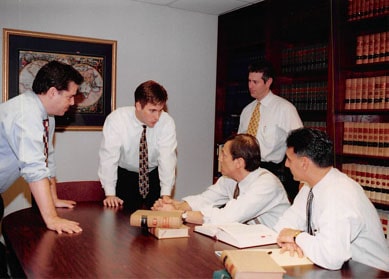
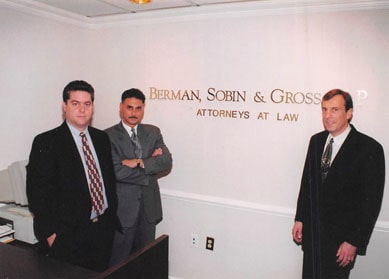
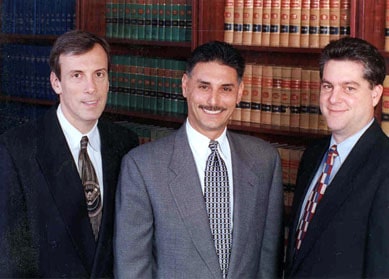
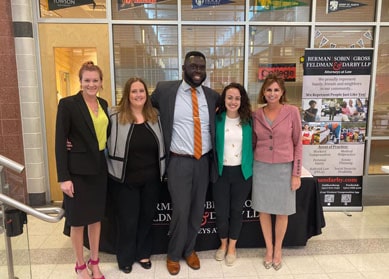
Berman | Sobin | Gross LLP has spent 35 years representing the working people of Maryland and Washington, D.C. who carry the real weight of keeping this region running. The firm has grown from three attorneys in one office to more than 20 attorneys with offices across the state, including locations in Baltimore, Lutherville, Gaithersburg, and Frederick. That depth of presence matters for federal workers in Parkville and Baltimore County, who need attorneys who understand both the federal compensation framework and the local landscape of federal employers, medical providers, and agency offices where these claims play out.
One of the firm’s founders wrote the definitive two-volume treatise on workers’ compensation in Maryland. The attorneys at Berman | Sobin | Gross LLP have handled hundreds of workers’ compensation jury trials and appeals before Maryland’s highest courts. The firm is recognized across the legal community in Maryland for skill and determination in workers’ compensation litigation, and that reputation extends to federal employee injury claims, where the same rigor in building and presenting a case determines whether an injured worker gets the benefits they are owed.
When other attorneys have declined to take on a case or stopped short of what the situation required, Berman | Sobin | Gross LLP has stepped in. That is not a recent development. It is how the firm has operated for three and a half decades.
Talk to a Federal Employee Injury Lawyer About Your Claim
Federal injury claims move on tight timelines and hinge on documentation that has to be right the first time. If you work for a federal agency in or around Parkville and you have been injured on the job, contact Berman | Sobin | Gross LLP for a confidential case analysis. The attorneys at this firm will review what happened, explain where your claim stands, and tell you honestly what it would take to pursue the benefits available to you under FECA. Reaching out to a Parkville federal employee injury lawyer costs nothing at the outset, and it may make all the difference in where your claim ends up.