

Oxon Hill Warehouse Worker Injury Attorney
Warehouse work in Oxon Hill and the surrounding Prince George’s County corridor is physically demanding by design. Workers in distribution centers, freight facilities, and storage operations along the Capital Beltway and Indian Head Highway lift, load, sort, and move goods under production pressure that rarely lets up. When an injury happens, it often happens fast, and it can end a worker’s ability to earn a living just as quickly. If you were hurt on the job at an Oxon Hill warehouse, understanding what Maryland workers’ compensation actually covers, and what can go wrong in the claims process, matters more than any general advice about injury law. The attorneys at Berman | Sobin | Gross LLP have spent 35 years representing Maryland workers in exactly these circumstances, and they know what these cases require.
What the Work Actually Looks Like, and Why the Injuries Are So Serious
Oxon Hill sits near the confluence of several major freight and logistics corridors in Prince George’s County. The area’s proximity to the Capital Beltway, I-295, and the National Harbor complex has made it home to a range of warehousing and distribution operations. Workers there are operating forklifts, working beneath elevated racking systems, loading and unloading commercial vehicles, and handling materials under shift quotas that create real pressure to move quickly.
The injuries that result from this kind of work are not minor. Forklift accidents cause crush injuries, amputations, and fatalities. Falls from loading docks or elevated platforms produce spinal fractures and traumatic brain injuries. Repetitive motion from packing and sorting lines creates cumulative damage to shoulders, wrists, and the lower back that worsens over months and years before a worker can no longer ignore it. Falling objects from inadequately secured racking injure workers who had no warning and no way to protect themselves.
These injuries often require surgery, extended recovery, and in some cases, permanent changes to what a worker can physically do. The difference between a workers’ compensation claim that covers all of that and one that covers the minimum the employer and insurer will agree to can be substantial.
Where Warehouse Workers’ Compensation Claims Break Down
Maryland’s workers’ compensation system requires employers to carry coverage and extends benefits to workers who are injured in the course of employment. In theory, the process is straightforward. In practice, warehouse workers face specific challenges that other types of injured employees may not encounter as frequently.
Employers and their insurers often challenge whether a cumulative injury, like a back condition built up over years of heavy lifting, meets the threshold for compensability. They may argue the condition is degenerative rather than occupational, shifting the burden to the worker to prove the work caused or significantly contributed to the injury. Independent medical examinations, which are conducted by physicians chosen by the employer’s insurance carrier, frequently produce opinions that minimize the severity or work-relatedness of the injury. A worker who accepts those findings without challenge may end up with far less than the injury actually warrants in terms of medical treatment, temporary disability payments, and permanent impairment benefits.
Warehouse workers who are undocumented or have uncertain immigration status sometimes avoid filing claims out of fear. Under Maryland law, immigration status does not bar an injured worker from receiving workers’ compensation benefits, and no employer or insurer can lawfully condition access to those benefits on that basis.
Claims also get complicated when a third party, beyond the employer and its insurer, shares responsibility for what happened. A defective forklift, an improperly maintained loading dock owned by a different entity, or equipment provided by a contractor can open the door to a separate personal injury claim on top of the workers’ compensation case. These two tracks require careful coordination so that nothing is left on the table.
What Berman | Sobin | Gross LLP Brings to Cases Other Firms Won’t Take
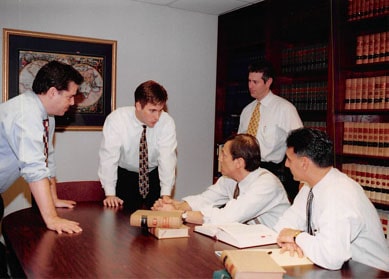
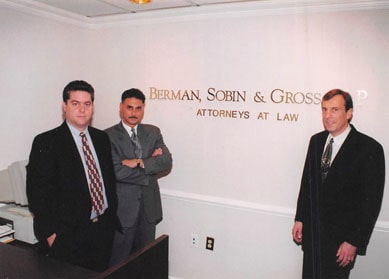
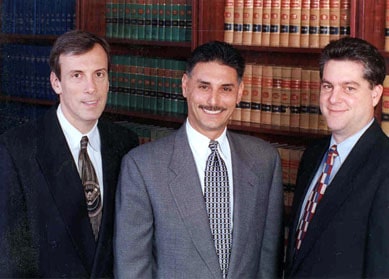
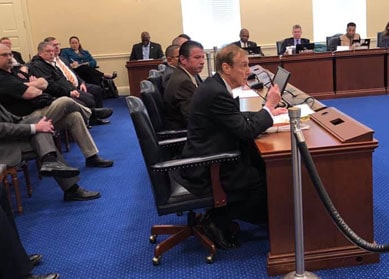
Berman | Sobin | Gross LLP is the largest workers’ compensation law firm in Maryland representing injured workers. That distinction reflects not just the size of the practice but the scope of cases the firm has been willing to handle. The attorneys here have represented clients in tens of thousands of hearings and have handled hundreds of workers’ compensation jury trials and appeals before both of Maryland’s highest appellate courts. When a case needs to go beyond the Workers’ Compensation Commission and into the circuit courts, or higher, the firm goes there.
One of the firm’s founders literally wrote the book on Maryland workers’ compensation, a two-volume treatise that has served as a primary reference for practitioners throughout the state. That depth of knowledge informs how every case is evaluated, including cases other attorneys have turned away or decided not to pursue past the administrative level. If you have been told your claim is too difficult or that your injury is too contested to fight, that assessment is worth a second opinion from attorneys whose entire practice is built around exactly these situations.
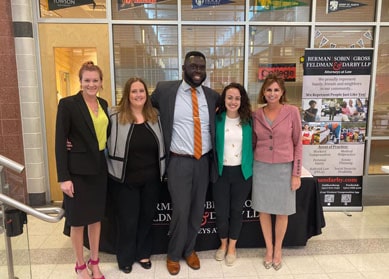
The firm also employs attorneys and staff members who are fluent in Spanish, which matters in a workforce as diverse as the one employed in Prince George’s County’s logistics and warehouse industry. Communication about a workers’ compensation claim should never be limited by a language barrier, and at Berman | Sobin | Gross LLP, it does not have to be.
Answers to Questions Warehouse Workers in Oxon Hill Often Ask
I was hurt at work but my employer says it was my fault. Do I still have a claim?
Maryland workers’ compensation is a no-fault system. You do not have to prove that your employer or a coworker was negligent to receive benefits. With limited exceptions for intentional self-harm, benefits are available simply because the injury arose out of and in the course of employment. Employer blame-shifting at the scene of an injury is a tactic, not a legal bar to your claim.
My injury built up over time from lifting. Is that covered the same way as a sudden accident?
Yes. Maryland workers’ compensation covers occupational diseases and cumulative injuries as well as acute accidents. Cases involving repetitive-motion injuries or gradual physical deterioration from work activities require medical documentation linking the condition to the employment, but they are compensable. These cases are more frequently contested, which is precisely why having experienced representation is important from the start.
How long do I have to file a workers’ compensation claim after a warehouse injury?
Maryland law generally requires that a claim be filed within two years of the date of the accidental injury or, for occupational disease claims, within two years of disablement or death. However, the time limits for notifying your employer are much shorter. Waiting to report an injury or file a claim can create complications that are difficult or impossible to fix later.
Can I choose my own doctor for treatment?
Initially, your employer and its insurer have the right to direct medical care. However, you have the right to seek a second opinion and to request authorization for additional treatment, and there are mechanisms through the Commission to challenge a denial of medical benefits. An attorney can help you understand what options are available given the specific circumstances of your claim.
What if the equipment that injured me was defective?
A defective forklift, a faulty conveyor system, or other malfunctioning equipment may give rise to a product liability claim against the manufacturer or distributor, entirely separate from your workers’ compensation case. These two claims can run at the same time, and pursuing both properly requires coordination between them to protect the value of each.
What does workers’ compensation actually pay for?
Maryland workers’ compensation covers medical treatment related to the injury, temporary disability payments while you are unable to work, permanent partial or permanent total disability benefits depending on the severity of lasting impairment, and vocational rehabilitation services in certain circumstances. What the insurer initially offers and what a properly documented and litigated claim can recover are often very different numbers.
Does filing a workers’ compensation claim put my job at risk?
Maryland law prohibits employers from retaliating against workers for filing workers’ compensation claims. If an employer fires, demotes, or otherwise penalizes a worker for pursuing a lawful claim, that conduct has legal consequences. Retaliation does happen, and workers who experience it have recourse.
Representing Oxon Hill Warehouse Injury Victims Throughout Prince George’s County
Berman | Sobin | Gross LLP handles cases across Maryland, with offices in Lutherville, Baltimore, Gaithersburg, and Frederick, and representation of workers throughout Prince George’s County including Oxon Hill. The firm serves workers regardless of where in the state the injury occurred and regardless of how complex the underlying claim has become.
If you have been injured in a warehouse or distribution facility in Oxon Hill, do not accept an initial denial or a minimal settlement offer as the final word. The attorneys at Berman | Sobin | Gross LLP will evaluate your claim honestly and tell you what it is worth and what pursuing full benefits will require. Contact the firm to speak directly with an Oxon Hill warehouse worker injury attorney about your situation.