

Owings Mills Delivery Driver Injury Attorney
Delivery driving has become one of the most physically demanding and genuinely dangerous occupations in Maryland. Whether you are navigating the residential streets of Owings Mills, making commercial stops near Owings Mills Town Center, or running routes along Route 795 and Reisterstown Road, the combination of traffic, time pressure, and constant physical loading puts drivers at serious risk every shift. When an injury happens, the question of how to recover benefits is rarely simple. An Owings Mills delivery driver injury attorney at Berman | Sobin | Gross LLP can help you understand exactly what you are owed and build the case to get it.
Why Delivery Driver Injuries in Owings Mills Raise Complicated Claims
Delivery driving injuries do not fit neatly into a single legal category. Depending on how the injury happened and who employs the driver, a claim might fall under workers’ compensation, a third-party personal injury action, or both simultaneously. That distinction matters enormously for what you can recover.
A driver employed by a logistics company or a national carrier and injured during a delivery is generally entitled to Maryland workers’ compensation benefits. Those benefits cover medical treatment, a portion of lost wages, and permanent impairment if the injury causes lasting limitations. But if another driver caused the accident, that opens a separate third-party claim against the at-fault motorist’s insurance. Maryland law allows injured workers to pursue both, and doing so correctly requires careful coordination so that any third-party recovery does not improperly reduce your workers’ comp entitlement.
The situation grows more tangled when the driver is classified as an independent contractor rather than an employee. Many delivery platforms and logistics companies use contractor classifications to reduce their own overhead, including their workers’ comp obligations. That classification does not automatically hold up. Maryland courts look at the real nature of the working relationship, including how much control the company exercises over the driver’s schedule, route, and conduct. If there is a legitimate argument that the worker was misclassified, that argument is worth making. Berman | Sobin | Gross LLP has the experience to evaluate classification disputes and has handled cases that required going beyond the initial administrative level to secure results.
The Injuries That Derail Delivery Careers
People outside the industry often underestimate how physically punishing delivery driving actually is. The occupational hazard is not limited to vehicle accidents. Repetitive motion injuries are common in drivers who lift, carry, and load hundreds of packages per shift. Back injuries, rotator cuff tears, and knee problems accumulate gradually and then reach a point where the worker simply cannot continue. These cumulative trauma claims can be harder to prove than a single-incident injury, but they are entirely compensable under Maryland workers’ compensation law when the work is the primary cause.
Slip and fall injuries are also frequent. Drivers are constantly stepping in and out of vehicles, climbing loading docks, crossing unfamiliar driveways and apartment complex entrances in all weather conditions. A fall on a wet loading surface at a commercial stop along Dolfield Boulevard or a trip on a broken walkway during a residential delivery can fracture bones and cause serious spinal injuries. When those falls happen on a third party’s property, the property owner may carry independent liability alongside the workers’ comp claim.
Vehicle accidents are the most immediately understood risk. Rear-end collisions, intersection accidents, and incidents involving commercial trucks on I-795 and the Baltimore Beltway near Owings Mills are real occurrences that send delivery drivers to trauma centers. Head injuries, cervical spine injuries, and lower extremity fractures are among the most serious outcomes, and the long-term treatment costs can be substantial. Workers’ comp covers medical treatment, but it does not compensate for pain and suffering the way a civil claim does. That is why understanding whether a third party is liable matters from the very beginning of the case.
What Happens After a Delivery Driver Gets Hurt on the Job
Maryland workers’ compensation law requires an injured worker to notify their employer of the injury and file a claim with the Maryland Workers’ Compensation Commission. Missing deadlines or giving an incomplete account of the injury to the employer early on can create problems down the road, and employers and their insurers are not always forthcoming about what the worker is entitled to receive.
Once a claim is filed, the insurer may authorize medical treatment, may direct the worker to a company-chosen physician, and will evaluate whether to pay or contest benefits. Contested claims go before the Commission for a hearing. If the dispute continues, there are avenues to appeal the Commission’s decision into the circuit courts. Berman | Sobin | Gross LLP has handled workers’ compensation cases through trial and has appellate experience in front of both of Maryland’s highest courts, which matters when a claim is genuinely disputed and the initial hearing result is not satisfactory.
For drivers dealing with a concurrent third-party claim, the timing and sequencing of settlements requires real attention. Taking a third-party settlement without accounting for the workers’ comp carrier’s subrogation rights can expose the worker to repayment obligations that eliminate much of the recovery. Handling both tracks together, with full awareness of how each affects the other, is exactly where legal representation makes the most concrete difference.
Questions Injured Delivery Drivers Ask Us
I was classified as a contractor, not an employee. Does that mean I have no workers’ comp rights?
Not necessarily. Maryland law focuses on the actual working relationship, not just the label the company assigned. If the company controlled your schedule, required specific uniforms or apps, and dictated how your routes were run, there may be a strong argument for employee status. This is worth a serious legal evaluation before accepting that no coverage exists.
The injury developed over time from repetitive lifting. Is that still a workers’ comp claim?
Yes. Maryland workers’ compensation covers occupational diseases and cumulative trauma conditions, not just single-incident accidents. The key is documenting the connection between your specific job duties and the medical condition that developed. Medical evidence from treating physicians plays a central role in these claims.
My employer’s insurer sent me to their own doctor and now my claim is being denied. What are my options?
Insurer-selected physicians frequently produce opinions that minimize injuries or dispute work-relatedness. You have the right to contest those opinions, obtain your own medical evaluation, and present that evidence at a Commission hearing. Berman | Sobin | Gross LLP regularly litigates cases where the employer’s medical expert opinion is the central dispute.
Can I be fired for filing a workers’ comp claim?
Maryland law prohibits retaliation against workers for filing workers’ compensation claims. If an employer terminates or otherwise penalizes a worker for asserting their legal rights under the workers’ comp system, that conduct can give rise to additional legal claims. Document everything that happens after you report an injury.
How long does a workers’ comp case in Maryland typically take?
Straightforward claims with accepted injuries and cooperative employers can resolve in months. Contested claims that go through hearings, potential appeals, and permanent disability negotiations often take considerably longer, sometimes years. The timeline depends heavily on the nature of the dispute, the severity of the injury, and whether the case requires litigation beyond the Commission level.
I settled my personal injury case against the other driver. Does that affect my workers’ comp benefits?
It can. When you receive a third-party settlement, the workers’ comp carrier may assert a right to recover the benefits it paid out of that settlement. How that calculation works, and how to structure the resolution to maximize what you actually keep, requires careful handling. This is one of the areas where legal representation at the outset prevents costly problems later.
What if my delivery injury happened while I was driving between stops rather than during an actual delivery?
Maryland workers’ compensation generally covers injuries that occur in the course of employment, and for delivery drivers whose entire work day involves moving between locations, coverage during travel between stops is typically included. The specific circumstances matter, and so does accurate documentation of exactly what you were doing and where you were when the injury occurred.
Delivery Drivers in Owings Mills Deserve Real Representation
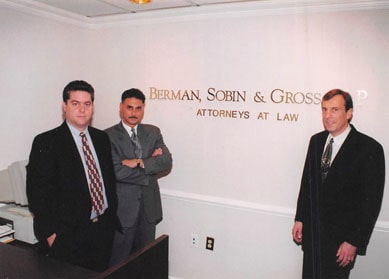
Berman | Sobin | Gross LLP is the largest workers’ compensation firm in Maryland representing injured workers. The firm has grown to more than 20 attorneys with offices throughout the state, and its attorneys have represented clients in tens of thousands of Commission hearings as well as hundreds of workers’ compensation jury trials. One of the firm’s founders authored the definitive two-volume treatise on workers’ compensation in Maryland, which remains the primary reference used across the state. When a claim is complex, disputed, or requires going beyond the administrative process into the courts, this firm does not turn those cases away. For delivery drivers in Owings Mills and the surrounding communities dealing with a serious work injury, that depth of experience is the practical difference between recovering what you are actually owed and leaving significant benefits on the table. Contact Berman | Sobin | Gross LLP to have your claim evaluated by an Owings Mills delivery driver injury lawyer who will stay with you from the beginning of your case through its resolution.