

Maryland Government Employee Injury Attorney
Government workers in Maryland carry an unusual legal burden that most private-sector employees never encounter. Whether you work for a state agency, a county government, a municipality, or a public school system, the path to full compensation after a workplace injury runs through a set of rules, presumptions, and procedural requirements that differ in important ways from standard workers’ compensation. A Maryland government employee injury attorney who understands those distinctions can make a substantial difference in what benefits you actually recover.
What Makes Public Employee Claims Legally Different in Maryland
Maryland’s workers’ compensation system covers most government employees, but the law treats certain categories of public workers with statutory presumptions that simply do not exist for private workers. Firefighters, law enforcement officers, correctional officers, paramedics, and EMTs benefit from occupational disease presumptions written into state law, meaning that certain conditions, including heart disease, hypertension, and lung disease, are presumed to be work-related unless an employer can affirmatively prove otherwise.
These presumptions are powerful, but they are not automatic. Employers and their insurers routinely challenge them, often by presenting medical experts who argue that the scientific basis for the presumption is unreliable. The Maryland courts have addressed this directly. In City of Frederick v. Shankle, the courts ruled that employer medical experts who give opinions attacking the scientific soundness of the public safety presumption are not permitted to testify. This is settled law that benefits public safety workers, but only if their attorneys know how to invoke it and defend against the tactics employers use to work around it.
The distinction between state and local government employment also matters. A state employee injured on the job may have a claim that runs through different administrative channels than a county or municipal employee doing similar work. Retirement status, pension systems, and disability benefit structures interact with workers’ compensation in ways that require careful coordination. An injured firefighter receiving a service-connected disability retirement, for example, may still be entitled to vocational rehabilitation services under Maryland law, a right established in the appellate decision Fikar v. Montgomery County.
Overtime, Light Duty, and Lost Wages for Public Safety Workers
One of the most common disputes in Maryland government employee injury cases involves wage replacement when a worker is placed on light duty. Public safety employees frequently earn a significant portion of their total compensation through overtime. When an injury removes the ability to work overtime, the income loss is real and immediate, even if the employer is paying a base salary while the worker sits at a desk.
Maryland appellate courts have addressed this squarely. In Montgomery County v. Deibler, the courts held that public safety workers receiving full salary on light duty can still recover compensation for lost wages they had been earning through overtime prior to the injury. This matters because employers and their insurers often take the position that a worker on full salary has no wage loss claim at all. That position is legally incorrect when regular overtime was a consistent part of the worker’s earnings history, but it takes a well-documented record and a lawyer willing to push past the administrative hearing level to establish it.
Calculating the correct average weekly wage for a government employee who earns overtime, shift differentials, or hazard pay requires more than a simple review of base salary. The wage calculation forms the foundation of the temporary total disability and permanent partial disability benefits, so errors in that calculation compound over the life of a claim.
The Hearing Process and When Cases Go Beyond the Commission
Most Maryland workers’ compensation claims are resolved at the Workers’ Compensation Commission through hearings before commissioners. For government employees, particularly those in public safety roles, these hearings often involve contested medical evidence, disputes over causation, and arguments about the scope and application of statutory presumptions. The Commission handles these disputes administratively, but the Commission’s decision is not necessarily the final word.
Maryland allows circuit court appeals from Commission decisions, and in appropriate cases, appeals proceed to the Court of Special Appeals or the Court of Appeals. The law governing public safety employee claims has been substantially shaped by appellate decisions. Attorneys at Berman Sobin Gross LLP have argued and won appeals before both of Maryland’s highest courts that have changed how the law applies to injured workers across the state, including the cases discussed on this page. That kind of appellate experience is relevant to government employee injury cases in particular, because the legal questions in these claims are complex enough that significant disputes often cannot be resolved at the administrative level.
Cases involving occupational disease, presumption disputes, or contested retirement disability interactions are among the most likely to require circuit court litigation or appellate review. A claimant whose attorney is not prepared to take a case into the courts is at a disadvantage in any negotiation or hearing where the employer knows that threat is not real.
Questions Government Workers Ask About Their Injury Claims
Does the workers’ compensation presumption for heart disease apply if I’ve already retired?
Yes, under Maryland law as clarified in Montgomery County v. Pirrone, the presumption that heart disease, lung disease, and hypertension are job-related applies to public safety workers even after retirement and while off duty. The presumption does not vanish when an employee leaves active service.
I’m a school employee, not a firefighter or police officer. Do these rules apply to me?
Most of the specific statutory presumptions apply to public safety categories. School employees, teachers, and school support personnel are covered by Maryland workers’ compensation for injuries and occupational diseases, but they do not have the same presumption protections unless the nature of the work falls within a covered category. The analysis turns on the specific diagnosis and the conditions of employment.
My employer says I forfeited my workers’ comp rights because I accepted a disability pension. Is that true?
This is a common misstatement of Maryland law. Workers’ compensation benefits and service-connected disability retirement are separate systems, and accepting one does not automatically bar recovery under the other. The interaction between these systems is complex, and the specific terms of a collective bargaining agreement or pension plan may affect the analysis, but a blanket waiver argument is frequently wrong.
Can I bring a personal injury lawsuit against my employer if I’m a government worker injured on the job?
Maryland workers’ compensation is generally the exclusive remedy against an employer for work-related injuries, which means separate lawsuits against a government employer are typically barred. However, if a third party, such as a manufacturer of defective equipment, a contractor, or a driver who caused a vehicle accident during work hours, contributed to the injury, a separate personal injury claim against that third party may be available alongside the workers’ compensation claim.
What happens if my injury was caused by conduct from a coworker or supervisor?
In most circumstances, coworker negligence is covered within the workers’ compensation system rather than through a separate suit. Intentional acts by coworkers or supervisors can create different legal questions, but the analysis is fact-specific and depends on how the conduct is characterized under Maryland law.
How long do I have to file a workers’ compensation claim as a Maryland government employee?
Maryland law generally requires that a claim be filed within two years of the date of accidental injury or the date of disablement from an occupational disease. Missing these deadlines can bar a claim entirely. For occupational diseases, the deadline runs from when the worker knew or reasonably should have known of the disease and its connection to the job, which can make the calculation less straightforward than it appears.
My workers’ comp claim was denied after a Commission hearing. Are my options exhausted?
No. Commission decisions can be appealed to the circuit court, and if legal questions of broader significance are present, the case may proceed further. Berman Sobin Gross LLP has represented injured workers through the full appellate process and has won decisions that changed the law for all similarly situated employees in Maryland. If another attorney has told you there is nothing more to do, a second evaluation by a firm with actual appellate experience in these cases is worth pursuing.
Representing Injured Government Workers Across Maryland
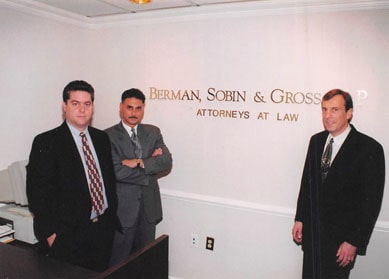
Berman Sobin Gross LLP is the largest workers’ compensation firm in Maryland representing injured workers, with offices in Lutherville, Baltimore, Gaithersburg, and Frederick and clients throughout the state. The firm has represented firefighters, paramedics, EMTs, law enforcement officers, corrections officers, teachers, and school support personnel for 35 years. The attorneys at the firm have handled tens of thousands of Commission hearings, hundreds of jury trials, and appellate cases that have shaped the law governing Maryland government employee injury claims. The firm has Spanish-speaking attorneys and staff available to serve clients without language barriers, and clients work with a single attorney who stays with them from the start of a case through its resolution. If you are a government employee in Maryland who has been injured at work and are not certain your claim is being handled correctly, contact Berman Sobin Gross LLP for a confidential case analysis with a Maryland public employee workers’ compensation attorney.