

Hyattsville Roofer Injury Attorney
Roofing is one of the most physically punishing trades in Maryland. Workers spend long shifts on pitched surfaces, often in summer heat that bakes the shingles beneath their feet, carrying loads that would strain anyone, relying on equipment that has to work perfectly or the consequences are catastrophic. When a roofer falls, the injuries are rarely minor. Broken vertebrae, traumatic brain injuries, shattered ankles, torn shoulders, spinal cord damage. The medical bills arrive fast, the ability to earn slows or stops, and the workers’ compensation system that is supposed to absorb that shock can feel designed to do the opposite. If you are a roofer in the Hyattsville area who has been hurt on the job, working with a Hyattsville roofer injury attorney at Berman | Sobin | Gross LLP gives you access to a firm that has spent 35 years taking on exactly this kind of fight.
What Roofing Work in the Hyattsville Area Actually Looks Like, and Why It Goes Wrong
Prince George’s County and the neighborhoods surrounding Hyattsville include a dense mix of residential rowhouses, commercial flat roofs, and older apartment complexes that require constant maintenance and periodic full replacement. That demand keeps roofing crews busy year-round. It also creates conditions where shortcuts get taken, inspections get skipped, and equipment gets pressed into use past the point where it is reliable.
Falls from heights account for the largest share of fatal and serious roofing injuries nationwide, and the pattern holds locally. A scaffold that shifts when a crew member steps onto it. A ladder that was never properly secured to the structure. A rooftop edge where no guardrail was installed because the general contractor decided the job was short enough to skip the setup. A safety harness distributed at the start of the job that had never been inspected for integrity.
Materials also cause serious injuries in ways that do not always get reported accurately. Hot tar burns. Prolonged heat exposure leading to heat stroke. Repetitive stress injuries that build over years until a roofer simply cannot lift their arms without pain. Falls through fragile sections of older flat roofs, which are common on the commercial and institutional buildings that fill the corridors along Route 1 and University Boulevard.
The legal question in many of these cases is not only whether someone was injured, but who bears responsibility. When a roofing contractor employs a crew directly, workers’ compensation is the standard path. But roofing work frequently involves layered employment relationships. Subcontractors working under general contractors. Workers hired through staffing arrangements. Day laborers whose employment classification is deliberately left ambiguous. Each of those configurations affects which claims are available and who can be held accountable.
The Specific Obstacles Roofers Face After a Serious Injury
Maryland’s workers’ compensation system provides real benefits when it functions correctly. Medical treatment, temporary total disability payments while a worker cannot return to the job, permanent disability awards for lasting impairment. But the system does not run on autopilot in favor of injured workers.
Employers and their insurers have strong financial incentives to minimize claims. After a roofing injury, a worker may find that the insurance company is disputing whether the accident happened the way the worker described it. Or that an independent medical examiner, hired by the insurer, has produced an opinion that the worker’s injuries are less severe than the treating physician documented. Or that a return-to-work offer has been structured specifically to cut off wage replacement benefits before the worker has fully recovered.
Roofing workers face particular pressure in this system. The work is physically defined in ways that make partial recovery functionally equivalent to full disability for the job. A roofer with a permanent knee impairment rating that looks modest on paper may be completely unable to return to work on a pitched roof. The gap between what the workers’ comp system classifies as “partial” disability and what actually ends a career in this trade is often enormous, and closing that gap requires knowing how to present the evidence and argue the medical record effectively.
There are also situations where a third party shares responsibility for what happened. If a defective piece of equipment caused a fall, the manufacturer may be liable. If a property owner’s negligence created the hazardous condition that injured the crew, a separate personal injury claim may run alongside the workers’ compensation case. These possibilities do not get identified automatically. They require an attorney who is paying attention to the whole picture from the beginning.
How Berman | Sobin | Gross LLP Handles Roofing Injury Cases
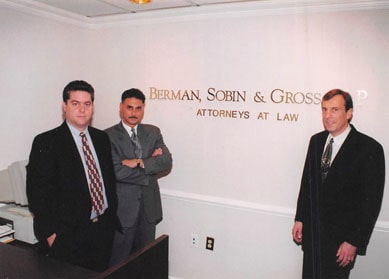
Berman | Sobin | Gross LLP is the largest workers’ compensation law firm in Maryland representing injured workers. The firm has handled tens of thousands of hearings and hundreds of workers’ compensation jury trials, including appeals before both of Maryland’s highest courts. One of the firm’s founders authored a two-volume treatise that remains the authoritative reference on workers’ compensation practice in Maryland. That depth of experience matters in roofing cases because these cases frequently become complicated.
The firm does not look for easy claims. When a case requires significant resources to pursue properly, including expert witnesses, vocational rehabilitation specialists, or litigation before the courts rather than just the Commission, Berman | Sobin | Gross LLP pursues it. If another attorney has declined to take a roofing injury case past the administrative stage, that is a reason to call this firm and have the claim evaluated, not a reason to accept a poor outcome.
Clients who work with Berman | Sobin | Gross LLP are assigned an attorney who remains their point of contact from the beginning of the case through its conclusion. The firm has attorneys and staff who are fluent in Spanish, which matters in a trade where a significant portion of the workforce communicates in Spanish and deserves to receive legal representation without language serving as a barrier to understanding what is happening with their claim.
What Injured Roofers and Their Families Actually Need to Know
I was injured while working on a subcontract job. Do I still qualify for workers’ compensation in Maryland?
Maryland law generally requires that workers who qualify as employees be covered by their employer’s workers’ compensation insurance, and it also provides protections in situations where a subcontractor’s employer has no coverage. The analysis depends on the employment relationship and the structure of the contract chain. It is worth having that structure reviewed by an attorney before assuming you have no path to benefits.
The employer’s insurance company wants to send me to their own doctor. Do I have to go?
In Maryland workers’ compensation cases, the insurer typically has the right to have an injured worker examined by a physician of their choosing. That examination will likely produce a report used against your claim. You have the right to be evaluated by your own treating physicians, and your attorney can help ensure the record reflects the full extent of your injuries, not just what the insurer’s examiner documented.
What if I cannot return to roofing at all after my injury?
Permanent disability benefits under Maryland workers’ compensation are designed to address lasting impairment, and vocational rehabilitation services may also be available. Maryland appellate decisions that Berman | Sobin | Gross LLP has been involved in have helped clarify the rights of injured workers who are receiving disability benefits to also access vocational rehabilitation. The firm understands how to pursue the full range of benefits available when a worker’s career is effectively ended by an injury.
How long do I have to file a workers’ compensation claim after a roofing accident?
Maryland law imposes filing deadlines on workers’ compensation claims. Missing those deadlines can extinguish your right to benefits entirely. The specifics depend on when you knew or should have known that your injury was work-related, which in the case of repetitive stress injuries can be a more complex question than it is for an acute fall. Getting legal guidance quickly avoids losing rights through delay.
Can I sue the property owner if their negligence contributed to my injury?
In some circumstances, yes. If a third party’s negligence, meaning someone other than your employer, contributed to the conditions that caused your injury, a personal injury claim separate from workers’ compensation may be available. These two types of claims can run at the same time, and the recoveries are structured differently. Whether this applies to your situation depends on the specific facts of how the accident occurred.
What if my employer says the injury was my own fault?
Maryland’s workers’ compensation system does not require that an injury be someone else’s fault in order to qualify for benefits. The system is no-fault in the sense that a worker’s ordinary negligence does not bar recovery. However, employers and insurers raise fault arguments to discourage workers from pursuing claims. An attorney can evaluate whether such an argument has any real basis in your case.
What does it cost to have Berman | Sobin | Gross LLP handle my claim?
Workers’ compensation representation at Berman | Sobin | Gross LLP is handled on a contingency basis. Attorney fees in Maryland workers’ compensation cases are regulated and approved by the Workers’ Compensation Commission. You do not pay upfront costs to pursue your claim.
Talking to a Hyattsville Roofing Accident Lawyer Is the Right Next Step
Roofing injuries change lives quickly and completely. The path back to stability, whether that means recovery and return to work or securing the long-term benefits that reflect the reality of a permanent limitation, runs through the workers’ compensation system. That system responds to preparation, evidence, and persistence. Berman | Sobin | Gross LLP has served injured workers throughout Prince George’s County and the greater Hyattsville area for more than three decades, from initial claims through Commission hearings and into the courts when that is what the case requires. Contact the firm for a confidential case analysis with a Hyattsville roofing accident lawyer who will stay with you and your case from beginning to end.