

Glen Burnie Government Employee Injury Attorney
Government workers in Glen Burnie carry significant responsibility. From Anne Arundel County employees and school system staff to corrections officers and public works crews, these workers face physical demands and occupational hazards that private-sector employees often do not. When a job-related injury occurs, the path to benefits is rarely straightforward. A Glen Burnie government employee injury attorney who understands the specific statutes, presumptions, and agency dynamics that apply to public sector workers can make a decisive difference in the outcome of a claim.
What Sets Government Worker Claims Apart in Anne Arundel County
Government employment in Maryland comes with a distinct legal framework layered on top of the standard workers’ compensation system. Depending on whether a worker is employed by the county, the state, or a municipality, different rules govern eligibility, compensation rates, and the appeals process. Many government employees also belong to unions or have employment contracts that create parallel rights and obligations alongside a workers’ comp claim.
For public safety workers, Maryland law provides enhanced protections that do not exist in standard workers’ compensation claims. Firefighters, EMTs, paramedics, law enforcement officers, and corrections officers may be entitled to statutory presumptions that treat certain diagnoses, including heart disease, lung disease, and hypertension, as job-related conditions. That presumption shifts the burden of proof in a meaningful way. Without it, an injured worker must affirmatively demonstrate the job connection. With it, the employer must disprove it.
Anne Arundel County is home to a large concentration of government workers. Glen Burnie sits in the middle of that workforce, with proximity to BWI, county administrative offices, the Anne Arundel County Department of Public Works, and multiple school system facilities. Workers in each of these environments encounter different types of injury risks, and the identity of the employer matters when determining which legal mechanisms apply.
How Maryland’s Occupational Disease Presumptions Actually Work in Practice
The presumption that certain conditions are job-related exists on paper, but employers and their insurers routinely challenge it. The way that challenge plays out at the Workers’ Compensation Commission and, in contested cases, before a jury, depends heavily on the quality of medical evidence, the legal arguments made, and how the case was built from the beginning.
Berman | Sobin | Gross LLP has handled this issue at the appellate level. In City of Frederick v. Shankle, the firm established that employer medical experts who argue the scientific basis for the public safety presumption is unsound cannot testify to that effect. In Montgomery County v. Pirrone, the firm secured a ruling that the heart, lung, and hypertension presumption applies even after retirement or while off duty. These are not abstract legal victories. They are precedents that directly change what government employees in Maryland can recover when they get sick or hurt.
For a government worker in Glen Burnie, the practical meaning of these decisions is this: the law is on your side in ways that go beyond standard workers’ compensation, but only if someone argues those rights correctly. An employer’s lawyer will know the precedents. Your lawyer should too.
Injuries That Appear Straightforward Until They Are Not
Some claims start simple. A public works employee slips on wet pavement, reports the injury the same day, and gets treatment. A school cafeteria worker tears a shoulder lifting food service equipment. These incidents seem clear-cut, but the complications tend to arrive later: a dispute over whether the treatment is necessary, a claim that the injury pre-existed the work incident, a disagreement about when maximum medical improvement was reached and what wage-replacement benefits are owed after that point.
Other claims are complicated from the start. A teacher who develops a repetitive stress injury over years of classroom work. A corrections officer diagnosed with PTSD after a traumatic incident. A county employee whose job-related toxic exposure only became apparent after leaving that role. These cases require more than paperwork. They require someone who has built cases on disputed medical causation, challenged employer-retained doctors, and taken cases past an administrative hearing when necessary.
Berman | Sobin | Gross LLP does not avoid difficult claims. The firm has handled hundreds of workers’ compensation jury trials and argued appeals before Maryland’s highest courts. If a case requires going further than an initial Commission hearing, the firm has done it, repeatedly, and in cases that other attorneys declined to take.
What Government Workers in Glen Burnie Should Know Before Filing
The time to make decisions about how a claim is handled is before major steps are taken, not after. Here is what matters early.
Reporting requirements are real deadlines. Maryland law requires workers to notify their employer of a work-related injury promptly. Missing that window can jeopardize the entire claim. Government employers often have internal reporting requirements on top of the statutory ones, and failing to comply with both can create problems even for claims that are otherwise valid.
The treating physician matters more than most workers realize. In many workers’ compensation claims, the employer or insurer has a role in directing initial medical care. The opinions of those physicians, including their assessments of causation, impairment, and work capacity, will shape what benefits are offered. Getting an independent evaluation early, and understanding what the records actually say, is often what separates a fully compensated claim from one that gets closed out prematurely.
Light duty assignments come with their own set of issues. Montgomery County v. Deibler, a case Berman | Sobin | Gross LLP won, established that public safety workers on light duty can still receive compensation for lost overtime wages they were earning before their injury. That matters significantly for workers whose compensation included regular overtime, which is common in government employment.
Questions Glen Burnie Government Workers Ask About Injury Claims
Does Maryland workers’ compensation cover occupational diseases, or only accidents?
Maryland workers’ compensation covers both traumatic injuries and occupational diseases. For government employees, particularly public safety workers, Maryland law provides specific presumptions for conditions like heart disease, hypertension, and certain respiratory conditions, treating them as job-related without requiring the worker to prove the job caused them.
What happens if my employer’s doctor says I can return to work but I do not feel ready?
An employer’s medical opinion is not the final word. You have the right to seek an independent medical evaluation, and disputes over work capacity can be presented to the Workers’ Compensation Commission. An attorney can help you understand what the medical record actually supports and whether it is worth challenging an employer’s position.
I am a county employee, not state. Does that change what benefits I can receive?
The identity of the employer matters. County employees in Anne Arundel County are covered under Maryland’s workers’ compensation system, but specific benefits, particularly enhanced benefits for public safety employees, depend on job classification and the applicable statutes. An attorney familiar with government employment claims can identify which provisions apply to your specific situation.
Can I receive workers’ compensation benefits and continue receiving my government pension or disability benefits?
The intersection of workers’ compensation, pension benefits, and service-connected disability retirement is a real issue for government workers. In Fikar v. Montgomery County, Berman | Sobin | Gross LLP established that workers receiving service-connected disability retirement are still entitled to vocational rehabilitation services. The relationship between these programs is not always additive, and coordination matters.
My injury happened gradually over years of government work. Can I still file a claim?
Yes. Cumulative trauma injuries and occupational diseases are covered under Maryland workers’ compensation. The question is often when the injury legally “occurred” for purposes of reporting and filing deadlines, which affects how the claim is structured. These cases benefit from legal guidance before a claim is filed rather than after a mistake has been made.
What if my workers’ compensation claim was denied or the benefits offered were far less than I expected?
A denial or an inadequate offer is not the end. Claims can be contested before the Workers’ Compensation Commission, and if necessary, cases can be appealed beyond the Commission into the circuit courts and higher. Berman | Sobin | Gross LLP has handled that entire range of proceedings, including jury trials and appeals before Maryland’s appellate courts.
If another attorney already told me my case is not worth pursuing, should I get a second opinion?
Yes. Some cases are declined by attorneys who do not handle complex or contested government employee claims. Berman | Sobin | Gross LLP specifically takes on difficult cases that other attorneys have turned down, and the firm evaluates claims that others have passed on. Whether a second opinion changes the outcome depends on the facts, but it is worth the conversation.
Representing Government Workers Throughout the Glen Burnie Area
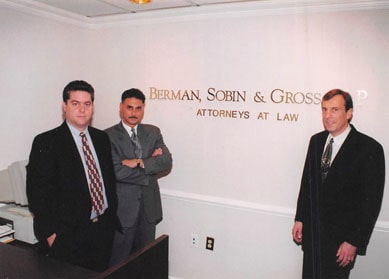
For over 35 years, Berman | Sobin | Gross LLP has represented Maryland government workers, including firefighters, EMTs, law enforcement officers, corrections officers, teachers, and school support personnel. The firm is the largest workers’ compensation firm in Maryland representing injured workers, with attorneys at offices in Lutherville, Baltimore, Gaithersburg, and Frederick, and with the resources and experience to handle claims anywhere in the state, including Anne Arundel County. The firm has attorneys and staff who are fluent in Spanish and can work with clients across language barriers without difficulty. When you retain an attorney at this firm, that attorney stays with you throughout the case. One point of contact, start to finish.
If you are a Glen Burnie government employee who has been injured on the job, contact Berman | Sobin | Gross LLP to have your claim evaluated by a government worker injury attorney who understands the public sector landscape in Maryland and has the record to handle whatever the case requires.