

Essex Restaurant Worker Injury Attorney
Restaurant work in Essex and the surrounding Baltimore County corridor is physically demanding in ways that rarely get acknowledged until something goes wrong. Line cooks work over open flame in crowded kitchens. Servers carry heavy trays across slippery floors for eight-hour shifts. Dishwashers and prep staff handle sharp equipment under time pressure. When injuries happen in this environment, workers often assume they just have to push through or risk losing their job. That assumption costs people real money and real medical care. An Essex restaurant worker injury attorney at Berman Sobin Gross LLP can help you understand what Maryland’s workers’ compensation system actually provides and how to claim it.
What Makes Restaurant Injuries Different from Other Workplace Claims
Restaurant injuries tend to cluster in patterns that are specific to the industry, and that specificity matters when you are building a claim. Slip and fall incidents in commercial kitchens are among the most common, but what makes them complicated is that they often happen in fast-moving environments where no one stops to document what caused the fall. Grease on a mat, a wet floor without a sign, an improperly drained area near the dish station, these conditions come and go within minutes. By the time anyone looks into what happened, the surface may look completely normal.
Repetitive strain injuries are another category that restaurant employers frequently contest. Carpal tunnel syndrome from repetitive chopping and knife work, shoulder injuries from carrying trays, back problems from lifting kegs or supply deliveries, these develop over time rather than in a single incident. Maryland workers’ compensation does cover occupational diseases and repetitive trauma, but the claims require more documentation than a straightforward acute injury. Establishing the connection between the work you were doing and the condition you developed is where legal representation makes a genuine difference.
Burn injuries, lacerations from kitchen equipment, and heat-related illness round out the picture. High-volume kitchens in Essex, particularly those operating in older commercial spaces without adequate ventilation, create real heat exposure risks during summer months. These are not exotic injuries. They are predictable consequences of the conditions restaurant workers operate in every day.
How Maryland Workers’ Compensation Actually Works for Food Service Workers
Maryland’s workers’ compensation system is a no-fault system, which means you do not need to prove your employer was negligent to receive benefits. What you do need to establish is that the injury arose out of and in the course of your employment. For restaurant workers, this usually means the injury happened on the premises, during your shift, while you were doing something connected to your job duties.
The practical starting point is reporting the injury to your employer. Maryland requires that employers be notified of an injury, and the sooner that happens the better. Many restaurant workers skip this step because they feel pressure to keep working or they do not realize how serious the injury is until days later. A delayed report does not automatically disqualify your claim, but it can create questions you will need to address.
Once a claim is filed with the Maryland Workers’ Compensation Commission, your employer’s insurer has the opportunity to accept or dispute it. In restaurant industry claims, disputes are more common than workers expect. Insurers may challenge whether the injury is as serious as reported, whether it was truly work-related, or whether prior conditions contributed to the problem. If a claim is disputed, it proceeds to a hearing before the Commission, and that is where having legal representation matters most.
The benefits available through workers’ comp include coverage for medical treatment, temporary total disability payments if you cannot work while you recover, and permanent disability awards if the injury causes lasting impairment. The wage replacement calculation is based on your average weekly wage, which for restaurant workers who earn tips can require careful documentation. Tip income that was not properly reported creates complications, but it does not necessarily mean those earnings cannot be accounted for in your claim.
When the Restaurant or a Third Party May Owe More Than Workers’ Comp Provides
Workers’ compensation is generally the exclusive remedy against your direct employer. That means you ordinarily cannot sue your employer in civil court even if their negligence caused your injury. But the restaurant industry involves a number of parties beyond just the employer, and that changes the analysis in certain situations.
If a piece of kitchen equipment failed because of a manufacturing defect, a product liability claim against the manufacturer may be available alongside your workers’ comp case. If a contractor who was working on the building created the hazardous condition that injured you, a separate third-party claim may be possible. If you were injured by another driver while making a delivery for the restaurant, the at-fault driver’s insurance is a separate source of recovery entirely.
These are not situations where you automatically receive more by filing additional claims, but they are situations worth examining carefully. Berman Sobin Gross LLP has handled workers’ compensation cases alongside related personal injury matters for decades, and identifying all available avenues of recovery is part of how the firm approaches representation.
Questions Essex Restaurant Workers Often Ask About Injury Claims
Can my employer fire me for filing a workers’ compensation claim?
Maryland law prohibits employers from retaliating against an employee for filing a workers’ compensation claim. If you experience adverse employment action after filing, that is a separate legal issue worth discussing with an attorney.
What if I am undocumented? Can I still file a claim?
Maryland workers’ compensation benefits are available to workers regardless of immigration status. Immigration status is not a factor the Commission considers in evaluating a workplace injury claim.
My employer says I was an independent contractor. Does that affect my claim?
The label your employer puts on your work relationship is not the final word. Maryland applies a multi-factor test to determine whether someone is truly an independent contractor or was actually functioning as an employee. Many restaurant workers are misclassified. If you regularly worked set hours, followed the restaurant’s direction, and used the restaurant’s equipment, there is a reasonable argument you were an employee entitled to workers’ comp coverage.
I hurt my back lifting at work, but I had a prior back injury. Can I still recover benefits?
Yes. Maryland workers’ compensation covers aggravations of pre-existing conditions. If your work activities worsened an existing condition, that worsening is compensable. The prior injury becomes relevant to the extent of damages but does not bar your claim.
How long do I have to file a workers’ compensation claim in Maryland?
Generally, you have 60 days to report the injury to your employer and two years from the date of the injury, or from when you knew or should have known the condition was work-related, to file with the Commission. For occupational diseases or repetitive trauma conditions, the clock is calculated differently, which is another reason to get legal advice early.
Do I have to use the doctor my employer’s insurance company sends me to?
Maryland workers’ compensation requires that you initially treat with a provider authorized by the employer or insurer. However, you have rights around obtaining independent medical evaluations, and if the authorized provider is not addressing your condition properly, there are avenues to seek a change. This is a common frustration for restaurant injury claimants and something an attorney can help navigate.
What if my injury was partly my own fault?
Workers’ compensation in Maryland is a no-fault system. Your own contribution to an accident, except in cases of intentional self-harm or intoxication, does not eliminate your right to benefits. You do not have to prove the kitchen was negligent to receive coverage.
Representing Essex and Baltimore County Restaurant Workers
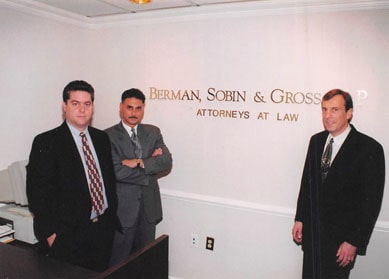
Berman Sobin Gross LLP has spent 35 years representing Maryland workers across industries and across the state, growing from a three-attorney firm to one of the largest workers’ compensation practices in Maryland. The firm represents workers throughout Baltimore County, including Essex and the communities along the eastern Baltimore corridor, and has offices in Lutherville and Baltimore that serve clients in this area. Spanish-speaking staff members are available, which matters in an industry where a significant portion of the workforce communicates primarily in Spanish. When you bring your case to this firm, the attorney assigned to you stays with you through the entire process, not just through an initial intake and then hand you off.
The attorneys at Berman Sobin Gross LLP have handled cases before the Maryland Workers’ Compensation Commission, in circuit courts across the state, and before Maryland’s appellate courts. The firm has pursued legislative changes that directly affected how workers’ compensation benefits are calculated and who qualifies for them. That depth of involvement in workers’ compensation law is what the firm means when it talks about being committed to injured workers beyond just the administrative hearing stage.
Talk to a Restaurant Injury Lawyer Serving Essex Before the Window Closes
Restaurant injury claims move on deadlines that workers do not always know exist, and gaps in documentation can be difficult to close after the fact. If you were hurt at a restaurant job in Essex or anywhere in Baltimore County, the attorneys at Berman Sobin Gross LLP are ready to review what happened and explain your options plainly. There is no obligation attached to that conversation, and having it sooner rather than later puts you in a better position no matter what you decide to do next. Reach out to a food service workplace injury attorney at Berman Sobin Gross LLP today.