

Dundalk Job Injury Attorney
Dundalk’s working population shows up for some of the toughest jobs in the region. Stevedores, warehouse workers, mechanics, laborers at the marine terminals along Bear Creek and the Patapsco, tradespeople at the industrial facilities that line Merritt Boulevard and Dundalk Avenue. These are physical jobs, and physical jobs carry real risk. When something goes wrong on a worksite, the question of what to do next matters enormously. A Dundalk job injury attorney at Berman | Sobin | Gross LLP has been representing Maryland’s working people for 35 years, and we understand what is at stake for the workers and families in this community.
What Dundalk’s Industrial Economy Means for Workers’ Compensation Claims
The Baltimore County portion of Dundalk sits adjacent to some of the busiest port and industrial infrastructure in the mid-Atlantic. The Dundalk Marine Terminal handles cargo operations that require workers to operate heavy machinery, work at heights, manage moving loads, and navigate active vehicle traffic, all within the same footprint. Workers in this environment face falls, crush injuries, repetitive motion injuries from sustained physical labor, and hearing loss from chronic noise exposure.
Further inland, Dundalk’s commercial corridors support construction trades, HVAC and electrical contractors, food distribution, and manufacturing operations. These industries generate a wide range of compensable injuries: back injuries from lifting, shoulder tears, knee damage, head injuries from falling objects, and chemical exposures from industrial solvents and cleaning agents. The pattern of injury depends on the industry, and the way a claim gets handled often depends on understanding that industry.
Employers in these sectors tend to be either large corporate entities with dedicated risk management teams or mid-sized businesses that rely on their insurance carriers to manage claims aggressively. Neither is a reason to submit a claim without representation. The workers’ compensation system in Maryland is not designed to reward passivity.
Decisions That Determine How a Claim Unfolds
The first decision that shapes a Maryland workers’ compensation claim is reporting. Maryland law requires injured workers to notify their employer promptly after a work-related injury. Delay creates room for an employer or insurer to argue that the injury did not happen at work, or that it was not serious enough to report immediately. Documenting the injury, the date, the circumstances, and any witnesses at the earliest opportunity gives a claim its foundation.
The second decision involves medical treatment. In Maryland, employers and insurers often direct injured workers to specific doctors or clinics. Those providers have a relationship with the insurer. That does not mean their medical opinions will favor the worker. When an authorized treating physician returns a worker to full duty prematurely, or attributes the injury to a pre-existing condition, the effect on benefits can be immediate. Knowing when and how to seek an independent medical evaluation matters.
The third decision, and often the most consequential, is whether to accept a settlement or push for full benefits. Lump sum settlements in Maryland workers’ compensation cases can look attractive while leaving significant future medical coverage and wage benefits on the table. A settlement that closes out medical benefits permanently may save an insurer money while leaving a worker without coverage for a surgery they will need in three years. That calculation deserves careful attention before any agreement is signed.
The Range of Benefits Available Under Maryland Workers’ Compensation
Maryland’s workers’ compensation system covers more than the immediate medical bills from an injury. Temporary total disability benefits replace a portion of lost wages while a worker is unable to return to work. Temporary partial disability benefits apply when a worker returns to lighter duty at reduced pay. Permanent partial disability benefits address lasting impairment to a body part or function, even after a worker has returned to work. Permanent total disability benefits apply to workers whose injuries leave them unable to return to gainful employment at all.
Vocational rehabilitation is available to workers who cannot return to their prior occupation. This can include retraining, job placement assistance, and related support. The Maryland Workers’ Compensation Commission oversees these benefits, and obtaining them often requires hearings before a Commissioner, medical evidence, and legal advocacy.
For workers in specific occupations, additional protections apply. Occupational diseases, including those related to chemical exposure or repeated physical stress, are compensable under Maryland law when the disease arises out of the nature of the employment. Some Dundalk workers, particularly those with long histories in port operations or industrial facilities, develop conditions over time rather than through a single traumatic event. These claims require a different type of medical and legal analysis than acute injury cases.
Questions Dundalk Workers Ask Before Moving Forward
My employer said the injury was my fault. Does that end my workers’ compensation claim?
No. Maryland operates a no-fault workers’ compensation system. A worker does not need to prove that an employer was negligent, and employer fault is not a prerequisite for benefits. With limited exceptions, an injury that occurs in the course of employment and arises out of the employment is covered regardless of how it happened.
The insurance company sent me to their doctor and the report does not reflect how I actually feel. What are my options?
An employer’s or insurer’s medical evaluation is not the final word on a claim. You have the right to seek an independent medical evaluation, and a physician selected by your attorney can provide a report that accurately reflects your condition. Conflicting medical opinions are common in contested workers’ compensation cases and are resolved by the Commission or a court.
I was injured at the Dundalk Marine Terminal. Does workers’ compensation cover maritime workers?
The answer depends on the specific nature of the work and the circumstances of the injury. Some maritime workers may be covered under federal law, specifically the Longshore and Harbor Workers’ Compensation Act, rather than Maryland’s state workers’ compensation system. The two systems differ significantly in their benefit structures and procedural rules. Determining which system applies is one of the first steps in a maritime-adjacent injury case.
My employer does not have workers’ compensation insurance. Can I still recover benefits?
Maryland maintains an Uninsured Employers’ Fund to compensate workers whose employers have failed to obtain required coverage. Claims against this fund involve specific procedural requirements. Additionally, an employer who has failed to carry required coverage may face personal liability through a civil lawsuit, which opens up broader damages than are available through workers’ compensation alone.
I returned to work but my injury has gotten worse. Is it too late to file a claim or reopen one?
Maryland allows workers to reopen workers’ compensation claims when there has been a change in condition. If your injury has worsened, or if symptoms that were previously manageable have become disabling, that change may support a modification of your prior award. There are time limits that apply to these requests, so acting promptly after a condition changes is important.
Can I be fired for filing a workers’ compensation claim in Maryland?
Maryland law prohibits employers from retaliating against employees for filing workers’ compensation claims. If a termination or demotion follows closely after a claim is filed, that timing can support a retaliation claim. These cases require their own analysis separate from the underlying workers’ compensation claim.
What happens if a third party, not my employer, was responsible for my injury?
In some cases, a party other than the employer, such as a contractor, equipment manufacturer, or property owner, may share responsibility for a work injury. Maryland law allows an injured worker to pursue a workers’ compensation claim and a separate civil lawsuit against the responsible third party. These claims can be pursued simultaneously and can result in significantly greater total recovery than workers’ compensation alone.
Representing Dundalk Workers at Berman | Sobin | Gross LLP
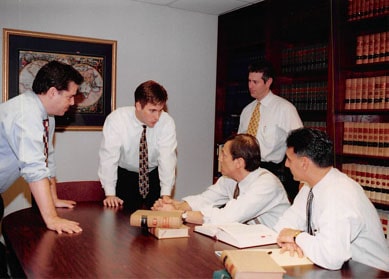
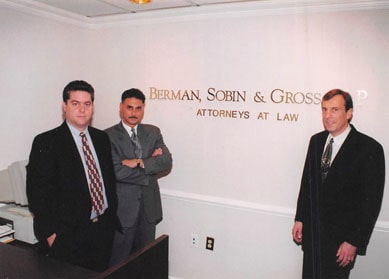
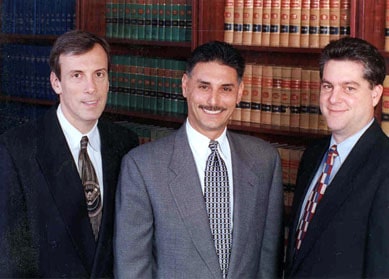
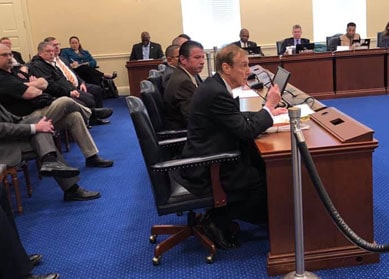
Berman | Sobin | Gross LLP is the largest workers’ compensation law firm in Maryland representing injured workers. The firm has offices throughout the state and has handled tens of thousands of hearings, hundreds of jury trials, and appeals before both of Maryland’s highest courts. One of the firm’s founders authored a two-volume treatise that remains the authoritative reference on workers’ compensation law in Maryland. This is not a firm that looks for the straightforward cases. It takes on the claims that have been turned away elsewhere and the cases that require going beyond the Commission and into the courts.
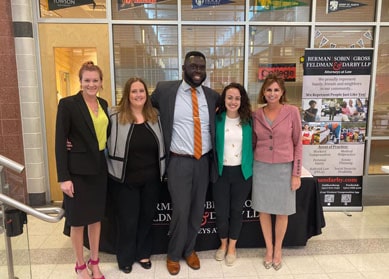
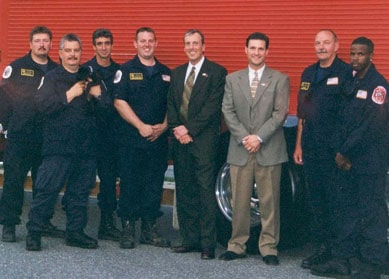
The attorneys at Berman | Sobin | Gross LLP represent firefighters, paramedics, law enforcement officers, corrections officers, teachers, truck drivers, and workers across every industry in Maryland. For Dundalk workers in port operations, construction, manufacturing, and the trades, the firm brings both the resources and the commitment to stay with a case through every stage of the process. Spanish-speaking attorneys and staff are available for clients who need to communicate in Spanish.
If your claim has been denied, underpaid, or handled in a way that does not reflect the seriousness of your injury, contact the job injury attorneys at Berman | Sobin | Gross LLP to have your claim evaluated by attorneys who know Maryland workers’ compensation law from the ground up and have built their practice around the workers who keep this state running.