

Columbia Restaurant Worker Injury Attorney
Restaurant work in Columbia is relentless and physically demanding. The lunch rush at a busy spot near the Mall in Columbia, the dinner service at a lakefront venue, the overnight cleanup crew at a chain kitchen in Owen Brown, all of these shifts carry real injury risk that most people outside the industry underestimate. When a cook suffers a severe burn, a server goes down on a wet floor, or a dishwasher strains their back hauling heavy racks, the workers’ compensation system is supposed to respond. In practice, getting what you are actually owed from that system often takes more than just filing paperwork. The attorneys at Berman | Sobin | Gross LLP have spent 35 years representing Maryland workers through every stage of this process, and a Columbia restaurant worker injury attorney at our firm can help you understand what your claim is genuinely worth and how to pursue it effectively.
The Injuries That Define This Industry and Why They Rarely Resolve Quickly
Restaurant injuries are not uniform. Some are sharp and sudden. Others accumulate over months of repetitive motion until one day the body simply stops cooperating. Both types are compensable under Maryland workers’ compensation law, and both types are frequently undervalued by employers and their insurance carriers at the outset.
Burns rank among the most common acute injuries in commercial kitchens, ranging from contact burns at the grill or oven to steam burns from industrial dishwashers, and grease splatter injuries that can require grafting and extended medical care. Slip and fall injuries on wet tile or grease-coated flooring can result in broken bones, torn ligaments, or traumatic head injuries. Cuts from slicing equipment, box cutters, and broken glass account for a significant share of restaurant injury claims as well, and in some cases nerve damage or tendon injuries from these incidents require surgical repair and months of rehabilitation.
Repetitive stress injuries develop more quietly. A prep cook who spends years making the same chopping and slicing motions may develop carpal tunnel syndrome or tendinitis serious enough to prevent continued work. Servers who are on their feet for eight or ten hours a day on unforgiving flooring sometimes develop stress fractures or degenerative joint issues that are directly connected to the cumulative demands of the job. These occupational disease and repetitive trauma claims tend to be the ones carriers dispute most aggressively, because pinpointing the exact moment of injury is impossible. Having attorneys who know how Maryland law handles this category of claim matters considerably for the outcome.
What Columbia’s Restaurant Workforce Actually Faces When Claims Are Filed
Howard County has a large and growing food service sector, and Columbia specifically has a dense concentration of restaurant workers across its village centers, the Columbia Town Center, and the commercial corridors along Route 29 and Route 108. Many of these workers are employed by large chain restaurant groups or franchise operations that carry substantial workers’ compensation insurance policies administered by carriers whose primary function is to manage claim costs. That dynamic matters for injured workers, because a carrier’s financial interest in limiting your claim runs directly counter to your interest in receiving the medical care and wage replacement benefits you need.
Delays in authorizing treatment are one of the most common complaints from injured restaurant workers. A carrier may contest whether a documented injury is work-related, or may approve only a portion of the recommended treatment, forcing the worker to either pay out of pocket, forgo care, or appeal the decision through the Maryland Workers’ Compensation Commission. Workers who do not understand this process often accept less than what they are entitled to, simply because the denial language in carrier correspondence sounds final when it is not.
Restaurant workers in Columbia also face a unique practical challenge: many earn a significant portion of their income through tips. When you are calculating lost wage benefits under Maryland’s workers’ compensation system, the methodology for capturing tip income requires careful documentation. Failing to account for tipped wages properly can result in wage replacement calculations that substantially understate your actual earnings, and by extension, your benefits. This is one of the details that benefits from having an attorney who has handled these claims specifically, not just workers’ compensation claims in general.
How Maryland Workers’ Compensation Law Applies to Restaurant Workers
Under Maryland law, virtually all restaurant employees are covered by workers’ compensation from their first day of employment. Coverage is not contingent on tenure, hours worked per week, or immigration status. If you were injured doing your job, the system is available to you. The key requirements are that the injury occurred in the course of your employment and arose from it, both of which are straightforward in most kitchen and service floor injury scenarios.
The benefits available through a successful Maryland workers’ compensation claim include payment for all reasonable and necessary medical treatment, temporary total disability benefits while you are unable to work, temporary partial disability benefits if you can work in a reduced capacity, and permanent disability awards if your injury causes lasting impairment. For restaurant workers whose injuries result in permanent restrictions that prevent them from returning to the physical demands of kitchen or service work, vocational rehabilitation may also be available under Maryland law.
One area where the law is less intuitive involves injuries that occur on employer premises but outside of a worker’s scheduled shift. Cases involving off-the-clock workers, injuries during required pre-shift preparation, and incidents on restaurant-owned property adjacent to the main building all carry specific factual questions that affect coverage. These edge cases are precisely where legal guidance adds the most value early in the process.
Questions Restaurant Workers in Columbia Frequently Ask About Injury Claims
My manager told me the injury was my fault. Does that prevent me from filing a workers’ compensation claim?
No. Maryland’s workers’ compensation system operates without regard to fault. Even if a workplace injury resulted partly from your own error, you are still generally entitled to benefits. The fault-based framework used in personal injury litigation does not apply here. What matters is that the injury happened at work while you were doing your job.
I work part-time at two different restaurants. Can I claim benefits from both employers?
This situation is more complex and depends on which employer you were working for when the injury occurred, along with how Maryland’s wage calculation rules apply to your circumstances. In some situations, earnings from concurrent employment can be factored into your average weekly wage calculation, which affects the benefit amount. This is worth discussing with an attorney who has handled concurrent employment wage disputes.
The restaurant I work for pays me in cash and never withheld taxes. Am I still covered?
Coverage under Maryland workers’ compensation law is not dependent on whether your employer properly handled payroll taxes. However, cash-pay arrangements can complicate documentation of your actual earnings. An attorney can help you gather the evidence needed to establish your true wage history for benefit calculation purposes.
My employer’s insurance company wants me to see their doctor. Do I have to go?
Under Maryland law, employers and their carriers have the right to have injured workers examined by a physician of their choosing. These independent medical examinations often produce opinions that minimize the severity of your injury or dispute the connection to your work. You are generally required to attend, but you should understand that the examining doctor’s opinion is not the final word. Attending with an attorney already involved in your case can affect how these evaluations are approached and challenged.
How long do I have to report my injury and file a claim in Maryland?
Maryland law requires that you report your injury to your employer promptly, and the general rule is that this should happen as soon as possible after the incident. There are also statutory filing deadlines for claims before the Maryland Workers’ Compensation Commission. Missing these windows can result in losing the right to claim benefits entirely, which is why early reporting matters even when you hope the injury will resolve on its own.
Can I be fired for filing a workers’ compensation claim?
Retaliating against an employee for filing a workers’ compensation claim is illegal under Maryland law. If your employment ends or your hours are cut shortly after you file, or if you are pressured not to report the injury, those facts may give rise to a separate legal claim in addition to your workers’ compensation case.
What if my injury was caused by dangerous equipment or a premises condition the restaurant knew about?
Workers’ compensation covers your claim regardless of how the injury was caused. However, if a defective piece of equipment manufactured by a third party contributed to your injury, there may be a separate product liability claim available against the manufacturer. These parallel claims are legally distinct from your workers’ compensation case and are worth evaluating when defective equipment is involved.
Representing Columbia’s Restaurant Workers Through Every Stage of the Claim
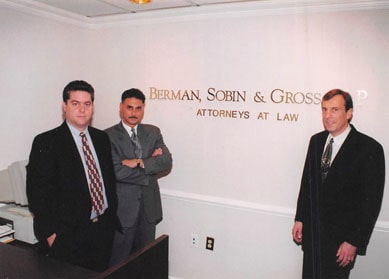
Berman | Sobin | Gross LLP is the largest workers’ compensation law firm in Maryland representing injured workers. The firm has handled hundreds of workers’ compensation jury trials and has argued appeals before both of Maryland’s highest courts. One of the firm’s founders authored a two-volume treatise on Maryland workers’ compensation that continues to serve as a primary reference in the field. That depth of litigation experience is not incidental to what restaurant injury clients receive. It means that when a carrier disputes a claim, denies treatment, or contests a disability rating, the firm is prepared to take the matter as far as it needs to go.
The firm also maintains Spanish-speaking attorneys and staff, which is directly relevant in Columbia’s restaurant workforce where a significant portion of kitchen and service staff are Spanish-speaking. No worker should have to navigate a workers’ compensation claim without being able to communicate clearly with their attorney.
When you begin working with an attorney at Berman | Sobin | Gross LLP, that attorney stays with you throughout your case. One consistent point of contact, one attorney who knows your file and your situation, is the way this firm operates across all of its cases.
A Columbia restaurant injury attorney at Berman | Sobin | Gross LLP is ready to review your claim, explain what benefits Maryland law makes available to you, and help you pursue them without settling for less than the full value of your case. Contact our office to arrange a confidential case evaluation.