

Bowie Federal Employee Injury Attorney
Federal employees in Bowie and throughout Prince George’s County work under a legal framework that is fundamentally different from the Maryland workers’ compensation system that covers most private-sector workers. When a Bowie federal employee injury attorney is needed, the distinction matters enormously: claims for federal workers run through the Federal Employees’ Compensation Act, administered by the Office of Workers’ Compensation Programs within the U.S. Department of Labor, not through the Maryland Workers’ Compensation Commission. The procedures, timelines, benefit structures, and appeal rights are distinct, and handling them well requires genuine familiarity with how OWCP operates in practice, not just a general background in workplace injury law.
Why Federal Employees in Bowie Face a Different Claims Process
Bowie sits in one of the most federally employment-dense corridors in the country. The National Security Agency, Joint Base Andrews, the U.S. Census Bureau, and dozens of federal agencies and contractors employ thousands of residents across Prince George’s County. Postal workers, federal law enforcement officers, Transportation Security Administration employees, civilian defense workers, and Social Security Administration staff all represent categories of federally employed workers whose injury claims are governed by FECA, not state law.
Under FECA, injured federal employees may be entitled to payment of all medical expenses related to a work injury, compensation for wage loss during periods of disability, and vocational rehabilitation services when appropriate. For workers who sustain injuries resulting in permanent impairment, schedule awards provide additional compensation. Survivors of federal employees killed in the line of duty may be entitled to death benefits under the same statute. The benefit structure is meaningful, but so is the documentation burden. OWCP requires precise completion of specific forms within defined timeframes, and a claim that is filed incorrectly, filed late, or supported by inadequate medical documentation can be denied even when the underlying injury is genuine and serious.
One aspect of FECA that routinely surprises injured workers is the relationship between FECA benefits and other federal retirement or disability programs. An employee receiving FECA wage-loss compensation cannot simultaneously receive Civil Service Retirement System or Federal Employees Retirement System disability benefits for the same period. Understanding when it makes sense to elect between benefit programs, and what the long-term financial consequences of each election look like, requires the kind of focused knowledge that comes from handling these cases regularly rather than occasionally.
The OWCP Process and Where Claims Break Down
Filing a federal workers’ compensation claim begins with formal notice to a supervisor and submission of the appropriate OWCP form, typically within three years of the date of injury for traumatic injuries, and within specific timeframes for occupational disease claims where the knowledge-of-relationship requirement applies differently. The speed with which initial forms are submitted, and the quality of the supporting medical evidence attached to those forms, directly affects how quickly benefits begin and how likely it is that OWCP approves the claim without a prolonged back-and-forth.
OWCP claims examiners review submissions and make initial decisions on acceptance or denial. When a claim is denied, the injured worker has the option to request reconsideration by OWCP, which triggers a review by a different examiner. If reconsideration also results in denial, a further appeal can be filed with the Employees’ Compensation Appeals Board, a federal administrative appellate body. At each stage, the quality of the medical and factual record matters. A denial that occurs because the initial submission lacked adequate causal documentation is not always correctable simply by adding more paperwork later, particularly when the ECAB is evaluating whether the agency had substantial evidence for its decision based on the record before it at the time.
Federal employees whose injuries involve the aggravation or acceleration of a pre-existing condition face particular difficulty. OWCP examiners and agency medical advisors regularly contest claims where the worker had a prior history of similar complaints. The legal standard under FECA does allow for coverage of aggravated pre-existing conditions, but meeting that standard requires a well-developed medical narrative that addresses causation in terms the OWCP review process will credit. This is not something a claimant can typically accomplish through self-representation, and it is one of the areas where the involvement of counsel makes the most practical difference.
What Berman | Sobin | Gross LLP Brings to Federal Injury Claims
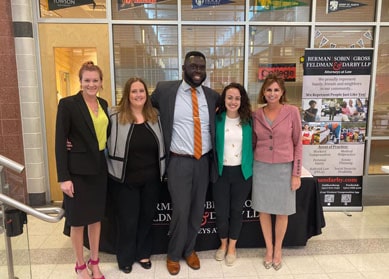
Berman | Sobin | Gross LLP has represented Maryland’s working men and women for 35 years, growing from three attorneys to more than 20 with offices throughout the state. The firm’s depth of experience in workers’ compensation claims, including complex occupational disease claims and cases that have reached Maryland’s highest appellate courts, provides a foundation that translates directly to the kind of detailed, evidence-driven representation that OWCP claims require. One of the firm’s founders literally wrote the treatise that serves as the definitive reference on workers’ compensation in Maryland, and that level of substantive investment in this area of law reflects how the firm approaches every case it takes.
Federal injury cases often involve clients who are police officers, corrections officers, paramedics, postal workers, or other workers in physically demanding roles that carry genuine occupational risk. These are exactly the categories of workers Berman | Sobin | Gross LLP has built its practice around. The firm represents firefighters, EMTs, law enforcement officers, and public safety workers as core clients, and has won appellate decisions at the Maryland Court of Appeals that expanded protections for precisely these categories of workers. That track record is not incidental. Firms that regularly handle the hardest cases develop capabilities that matter when a federal employee’s case becomes contested.
Clients who work with the firm are connected to a single attorney who stays with them through the duration of their case. For federal employees navigating the OWCP process, continuity matters. Reconsideration requests, ECAB appeals, and the coordination of medical evidence over months or years benefit from an attorney who knows the full history of the claim, not one who picks up a file at each new stage. The firm also has attorneys and staff fluent in Spanish, reflecting the real diversity of the workforce in Prince George’s County and the surrounding region.
Questions Federal Workers in Bowie Ask About Injury Claims
Does FECA cover injuries that happen during telework or remote federal work?
FECA can cover injuries that occur while a federal employee is working from home or performing remote duties, but the circumstances are evaluated carefully. OWCP examines whether the injury occurred within the time and space limitations of the employment and whether it arose out of an actual work activity rather than a personal activity. Telework claims are not automatically denied, but they require careful documentation of what the employee was doing at the moment of injury and how it connected to their official duties.
What happens if OWCP denies my claim?
A denial can be challenged through a reconsideration request filed with OWCP within one year of the decision. If reconsideration is also denied, an appeal to the Employees’ Compensation Appeals Board is available. ECAB decisions are based on the written record and are not live hearings in most cases. Building the strongest possible record before and during reconsideration is critical, because adding new evidence at the ECAB stage has limitations.
Can I receive both FECA wage-loss benefits and my federal retirement?
Not simultaneously for the same period of time. Federal law prohibits dual compensation from FECA and federal retirement disability benefits covering the same period. Choosing between programs has significant long-term financial implications, and the right choice depends on the nature and duration of the disability, the employee’s retirement status, and other individual factors. This is a decision that benefits from legal guidance before an election is made.
Are there limits on which doctors I can see under FECA?
OWCP authorizes treatment by physicians it recognizes and generally requires that treatment be related to the accepted condition. Changing treating physicians or seeking specialist care often requires prior OWCP authorization. Using a provider who is not recognized by OWCP, or obtaining treatment outside the authorized condition, can result in OWCP declining to pay for that care. Understanding the authorization process before seeking treatment helps avoid situations where medical bills become the employee’s personal responsibility.
How long does OWCP take to make a decision?
OWCP processing times vary, and a complete, well-documented claim will generally move faster than one that triggers requests for additional information. Traumatic injury claims are often processed within a few weeks when supporting documentation is complete at the time of filing. Occupational disease claims, which require more detailed medical causation evidence, frequently take longer. Delays are common and do not necessarily signal that a denial is coming, but they can create financial hardship during the waiting period.
What if my federal employer is disputing that my injury happened at work?
Agency opposition to a claim is a factor OWCP considers, but it does not control the outcome. OWCP conducts its own independent review of the evidence. When an agency contests a claim, the medical and factual record supporting the employee’s account becomes even more important. Statements from coworkers who witnessed the incident, contemporaneous incident reports, and a treating physician’s opinion that clearly connects the injury to the work event all carry weight in contested situations.
Does it matter that I am a public safety worker versus a civilian federal employee?
Both are covered by FECA, but certain conditions carry presumptions for specific occupational categories under federal law that do not apply to all workers. The nature of the work also affects how OWCP evaluates causation claims and what evidence is most probative. Federal law enforcement officers, for example, may have specific provisions that apply to heart conditions or other occupational diseases depending on the agency and job classification.
Connecting with a Federal Employee Injury Attorney Serving Bowie
Berman | Sobin | Gross LLP represents injured workers throughout Maryland, including federal employees in Prince George’s County and the communities surrounding Bowie who are dealing with OWCP claims, denials, and appeals. The firm takes on difficult cases that other attorneys decline, and it has the resources and depth of experience to pursue a claim through every available level of review. If you are a federal worker whose claim has been denied, who is struggling with OWCP documentation requirements, or who is simply trying to understand what your options are after a workplace injury, contact Berman | Sobin | Gross LLP to discuss your situation with a Bowie federal employee injury lawyer who will remain your point of contact throughout the process.