

Bowie Commercial Driver Injury Attorney
Commercial drivers in the Bowie area move goods, passengers, and essential services up and down Route 50, the Baltimore-Washington Parkway, and across Prince George’s County every day. The physical demands of that work accumulate in ways that are different from what most workers face: long hours in a fixed seat, repetitive loading and unloading, exposure to cargo hazards, and the constant physical toll of operating heavy equipment on roads that do not always accommodate the vehicles on them. When a driver is hurt, the workers’ compensation claim that follows is rarely straightforward. Jurisdiction questions, employer classification issues, and medical disputes make these cases harder than they look at the outset. A Bowie commercial driver injury attorney at Berman | Sobin | Gross LLP can help you understand what you are actually entitled to and make sure the claim reflects the full scope of what happened.
Why Commercial Driver Injuries Create Complicated Workers’ Compensation Claims
Most workers’ compensation claims involve an injury at a fixed worksite. Commercial driver injuries are different because the worksite moves with the driver. This creates questions that do not come up in other claims: Was the driver on a covered route at the time of injury? Does an accident on a loading dock count the same as one that happens while operating the vehicle? What if the driver was making a personal stop? These distinctions matter to insurers and to the Maryland Workers’ Compensation Commission, and employers do not always resolve them in the driver’s favor.
There is also the question of how the driver is classified. Some commercial drivers in the Bowie area work directly for a carrier as employees with full workers’ compensation coverage. Others are classified as independent contractors, which can affect their access to benefits even when that classification does not accurately reflect the working relationship. Maryland law has rules about when a contractor classification holds up, but those rules require a careful look at how the work was actually structured, how much control the employer exercised, and whether the driver had a genuine opportunity to run an independent business. If you were told you are not covered because you are a contractor, that determination deserves scrutiny before you accept it.
The injuries themselves also tend to be more medically complex. A single traumatic event, like a truck accident on Route 301 or a fall from a loading dock at a Prince George’s County distribution center, can produce orthopedic injuries, traumatic brain injuries, or internal trauma that require months of treatment and ongoing evaluation. But many commercial drivers also develop conditions that built up gradually over years: lumbar disc degeneration from constant vibration, rotator cuff damage from repetitive loading, hearing loss from engine noise. Occupational disease and cumulative trauma claims are harder to prove than acute injury claims, and they are more frequently challenged by employers and their insurers.
What Benefits a Commercial Driver in Maryland Can Claim
Maryland workers’ compensation covers more than just medical bills. Drivers who are taken out of work entirely may be entitled to temporary total disability benefits, which replace a portion of their average weekly wage during the recovery period. Drivers who can return to work in a limited capacity, perhaps driving shorter routes or doing light administrative work, may be entitled to temporary partial disability benefits to make up the gap between what they earned before and what they can earn now. If a condition becomes permanent, the Commission can award permanent partial disability benefits based on the rating assigned to the affected body part or system.
The wage calculation for commercial drivers requires particular attention. Overtime, per diem payments, and variable route pay can all affect the average weekly wage figure that forms the basis for most benefit calculations. Insurers sometimes calculate that number in a way that understates what a driver actually earned. The Commission allows for a fair calculation that accounts for all forms of compensable income, but it takes documentation and, often, a formal dispute to get there.
Vocational rehabilitation is another benefit that is frequently overlooked. If an injury leaves a driver unable to return to commercial driving, Maryland’s workers’ compensation system includes provisions for vocational rehabilitation services, which can help a worker transition to a different kind of work. The firm’s attorneys have pursued vocational rehabilitation claims before the Commission, including in cases where employers argued injured workers were not entitled to those services.
Third-Party Liability When Another Driver or Party Caused the Crash
Workers’ compensation is not always the only avenue available to an injured commercial driver. If the injury happened in a collision caused by another driver, a defective vehicle component, or a hazardous condition that a property owner was responsible for maintaining, there may be a separate personal injury claim against a third party. This matters because workers’ compensation has limits: it does not cover pain and suffering, and the wage replacement it provides does not equal full lost income. A third-party personal injury claim can pursue damages that fall outside the workers’ comp system entirely.
Bowie sits at a crossroads of heavily traveled corridors. The intersection of Route 50 and Route 301, the stretch of the Capital Beltway near the Prince George’s County border, and the industrial and distribution areas along Central Avenue see significant commercial truck traffic. Accidents involving commercial vehicles in these areas often involve multiple potentially liable parties, including the at-fault driver, the company that employed that driver, vehicle manufacturers if a mechanical failure contributed, and sometimes cargo loaders if improper loading affected vehicle handling. Identifying and pursuing all of those parties requires coordination between the workers’ comp case and the civil claim, which is something the attorneys at Berman | Sobin | Gross LLP handle routinely.
What Injured Commercial Drivers in and Around Bowie Ask Us Most
My employer says my injury is not covered because I was making a personal stop. Is that the final word?
Not necessarily. Maryland’s workers’ compensation law recognizes that commercial driving is different from a standard commute or office job. Whether a deviation from a route breaks the employment connection depends on how far the deviation went and what the driver was doing. This is a fact-specific question and one worth evaluating with an attorney before accepting the employer’s characterization.
I was classified as an independent contractor. Does that mean I have no workers’ comp rights at all?
Independent contractor status is not automatically disqualifying. Maryland law looks at the actual working relationship, not just what the contract says. If the hiring company controlled how and when you worked, provided the vehicle, and set the routes, you may qualify as an employee under Maryland’s workers’ compensation statute regardless of what the paperwork calls you.
My injury developed over time from repetitive work, not from a single accident. Can I still file a claim?
Yes. Occupational disease and cumulative trauma claims are a recognized category under Maryland workers’ compensation law. These claims are more difficult to document and are more often disputed, but they are not categorically excluded. Medical evidence linking the condition to the work you performed is central to how these claims are evaluated.
The insurer’s doctor says I can return to full-duty driving, but my own physician disagrees. What happens?
Conflicting medical opinions are common in workers’ compensation cases. The Maryland Workers’ Compensation Commission evaluates the evidence presented by both sides, and the insurer’s doctor does not automatically prevail. The strength of your own physician’s documentation, along with any independent medical assessments, plays a significant role in how those disputes are resolved.
Can my employer fire me for filing a workers’ compensation claim?
Maryland law prohibits retaliation against employees for filing workers’ compensation claims. If adverse employment action follows a claim, that conduct may give rise to a separate legal claim. If you believe you have experienced retaliation, document what happened and speak with an attorney.
How long do I have to file a workers’ compensation claim in Maryland?
The standard deadline for filing a workers’ compensation claim in Maryland is two years from the date of injury, or two years from when a claimant knew or reasonably should have known that the injury was work-related. For occupational disease cases, the timeframe can be measured differently. Filing well before any deadline gives your attorney the opportunity to build the strongest possible record.
What if my workers’ comp benefits were denied or terminated mid-treatment?
A denial or termination of benefits is not the end of the road. Both decisions can be challenged before the Maryland Workers’ Compensation Commission. The firm’s attorneys have handled cases that required hearings, jury trials, and appeals before Maryland’s highest courts, including cases where other attorneys had reached the limit of what they could accomplish at the Commission level.
What Working with Berman | Sobin | Gross LLP Looks Like for Bowie Drivers
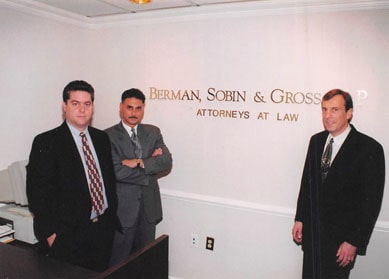
Berman | Sobin | Gross LLP has been representing injured workers throughout Maryland for 35 years. The firm has grown from three attorneys in a single office to more than 20 attorneys with offices statewide. One of the firm’s founders authored a two-volume treatise that remains the definitive reference on workers’ compensation practice in Maryland. The firm has handled tens of thousands of hearings and hundreds of workers’ compensation jury trials, and its attorneys have appeared before both of Maryland’s highest courts. Drivers in the Bowie area who have had claims denied, been classified in ways that cut off their benefits, or need someone willing to take a case through trial rather than settle for less than it is worth will find attorneys here who approach those situations without hesitation. When you work with this firm, you have a single attorney assigned to your case from start to finish, someone who knows your file and is reachable throughout the process. Spanish-speaking staff and attorneys are available for clients who prefer to communicate in Spanish.
If you were hurt while working as a commercial driver in the Bowie area, the attorneys at Berman | Sobin | Gross LLP are ready to evaluate your situation and help you understand the full scope of what you may be entitled to pursue. Contact the firm to speak with a Maryland commercial driver injury attorney about your claim.