

Maryland Custodial Worker Injury Attorney
Custodial workers keep Maryland’s schools, hospitals, office buildings, and public facilities running. They haul heavy equipment, handle industrial cleaning chemicals, work on wet floors, and move through spaces that most people never think twice about. The physical demands are constant, and the hazards are real. When a custodial worker injury takes someone off the job, the workers’ compensation system is the primary path to medical coverage and wage replacement. But that path has obstacles, and the outcome of a claim often depends on how it is handled from the start.
What Makes Custodial Work So Physically Punishing
People outside the industry often underestimate what custodial and janitorial workers absorb over the course of a shift. The job involves prolonged bending, kneeling, lifting, reaching overhead, and pushing heavy carts or floor equipment across long stretches. Repetition is a constant. A worker who mops floors or operates a buffer for eight hours a day, five days a week, is placing stress on joints, tendons, and soft tissue at a rate that accumulates into serious injury over time.
Slip and fall accidents are among the most common acute injuries in this field. Custodial workers are often in areas immediately after a spill has been reported, before the hazard has been controlled. Wet floors, cleaning product residue, and uneven surfaces across older Maryland facilities create a regular exposure to fall risk. Back injuries, knee injuries, and fractures are frequent results.
Chemical exposure is another occupational reality. Industrial cleaning agents, disinfectants, and solvents can irritate or damage the respiratory system, skin, and eyes with prolonged exposure or a single incident involving a splash or spill. Workers in hospitals and healthcare facilities face additional chemical exposure through cleaning agents required for sanitation standards.
Then there are the slower injuries. Carpal tunnel syndrome and other repetitive stress conditions develop over months or years of the same motions. Shoulder and rotator cuff damage from repeated overhead cleaning tasks. Chronic back conditions from lifting without adequate ergonomic support. These cumulative injuries are compensable under Maryland law, but they require more documentation than a single-incident accident, and employers and insurers often push back harder on them.
Maryland Workers’ Compensation and the Custodial Industry
Maryland’s workers’ compensation system covers employees who sustain injuries arising out of and in the course of their employment. That applies whether the injury was sudden or developed gradually over time. Custodial workers in Maryland who are injured on the job are generally entitled to medical benefits, temporary total disability benefits if they are taken off work, and permanent disability benefits if the injury results in lasting impairment.
The wrinkle for many custodial workers is that the workforce includes a significant number of contract employees and workers placed through staffing agencies. Whether a worker is treated as an employee or an independent contractor matters enormously for workers’ comp eligibility. Maryland law looks at the actual nature of the work relationship, not just what the contract says. Workers who have been misclassified as contractors when they function as employees may still have a viable workers’ compensation claim, but pursuing it requires navigating an additional layer of dispute.
Custodial staff employed by Maryland government agencies, school systems, or public institutions operate within a slightly different framework. Public employees are covered under Maryland workers’ compensation, but the process for filing and contesting claims can involve additional procedural steps and different insurance structures. Workers in public school systems across Montgomery County, Baltimore County, Prince George’s County, and elsewhere across the state fall into this category.
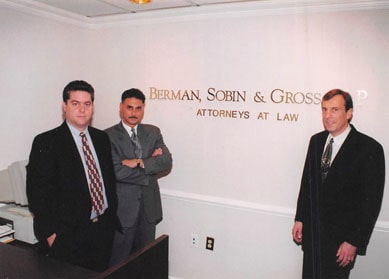
The Maryland Workers’ Compensation Commission handles disputes that arise when claims are denied, benefits are terminated prematurely, or the extent of a disability is contested. At Berman Sobin Gross LLP, our attorneys have represented clients through tens of thousands of Commission hearings and have handled hundreds of workers’ compensation jury trials. We go to the Commission and, when necessary, into the courts.
When Claims Get Complicated for Custodial Workers
Some custodial worker injury claims are straightforward. A worker slips on a wet floor, reports the injury immediately, receives medical treatment, and returns to work after a short recovery. But a meaningful number of claims hit friction at one stage or another.
Late reporting is a common problem. Custodial workers often try to push through pain, especially if they are part-time employees or are concerned about job security. Maryland law requires notice to the employer within 10 days of an injury, although the Commission has discretion to allow late-filed claims in certain circumstances. Waiting too long can jeopardize a claim and should be addressed immediately if it becomes an issue.
Pre-existing conditions create disputes. An employer or insurer may argue that a worker’s back injury or knee condition predated the workplace incident and is therefore not compensable. Maryland law allows recovery for aggravation of pre-existing conditions, but the insurer will frequently use independent medical examiners to dispute causation. Having medical documentation and legal representation ready to respond to those opinions matters.
Occupational disease claims, including those based on chemical exposure or repetitive motion injuries, face additional scrutiny. The insurer must be shown that the condition arose primarily from the employment, not from ordinary life activities. For custodial workers whose job requires significantly more physical strain than non-occupational life, that can be established, but the evidence must be assembled carefully.
Berman Sobin Gross LLP has built its reputation on handling the cases that require more work, not just the ones that settle easily. One of our firm’s founders literally authored the definitive legal treatise on workers’ compensation in Maryland. That depth of knowledge informs how we evaluate and pursue custodial worker injury claims.
Questions Custodial Workers Ask About Their Claims
My employer says my injury isn’t work-related because it developed slowly. Is that right?
No. Maryland workers’ compensation covers occupational diseases and cumulative injuries, not just single-incident accidents. Conditions like chronic back pain, carpal tunnel syndrome, or joint damage that developed from repetitive job tasks can qualify. The key is establishing that the condition arose from the employment. Medical documentation of the nature of your work and how it contributed to the injury is central to these claims.
I work for a staffing agency placed at a facility. Who is responsible for my workers’ comp coverage?
This depends on how the arrangement is structured. Generally, the staffing agency is the employer of record and carries workers’ compensation coverage. In some cases, the host employer may share or bear liability. If you’ve been told you’re an independent contractor but your day-to-day work looks like employment, that classification may be wrong, and your right to benefits may still exist.
The employer’s insurance company sent me to a doctor and that doctor says I can return to work. Do I have to comply?
You may be required to attend an insurance-arranged medical examination, but the opinion of that examiner is not final. You have the right to treatment with your own physician, and conflicting medical opinions can be presented at a Commission hearing. Insurance-retained examiners frequently produce findings that minimize disability. Your treating physician’s views carry weight in the process.
I reported my injury but my employer is pressuring me not to file a claim. What should I do?
Retaliation against workers for filing workers’ compensation claims is illegal in Maryland. Pressure to drop a claim or threats tied to a filing are serious and should be documented. The fact that an employer objects to a claim does not make that claim invalid. File the claim with the Maryland Workers’ Compensation Commission and speak with an attorney about both the workers’ comp matter and any retaliation concern.
My injury means I can’t go back to custodial work. What benefits are available for that?
Permanent disability benefits are available under Maryland workers’ compensation if your injury results in lasting impairment. If you are unable to return to your prior job, vocational rehabilitation may also be available. In some public employee cases, the interaction between disability retirement and workers’ comp benefits creates additional issues. An appellate decision our firm secured in Fikar v. Montgomery County addressed exactly this kind of situation, establishing that injured workers receiving service-connected disability retirement can still receive vocational rehabilitation services.
My workers’ comp claim was denied. Is that the end?
No. A denial from an employer or insurer can be contested before the Maryland Workers’ Compensation Commission. If the Commission’s ruling is unfavorable, further appeal is available to the circuit courts and, in appropriate cases, Maryland’s appellate courts. Berman Sobin Gross LLP has handled appeals before both of Maryland’s highest courts. A denial is a starting point, not a final answer.
How long does a custodial worker injury case typically take in Maryland?
Straightforward cases that resolve without dispute can move relatively quickly. Cases involving contested causation, permanent disability determinations, or occupational disease claims take longer, sometimes significantly so. There is no single timeline. What matters is that the claim is documented thoroughly from the beginning so that each stage of the process, if it proceeds, is built on solid ground.
Maryland’s Custodial Workforce Deserves Serious Representation
Custodial and janitorial workers appear throughout every sector of Maryland’s economy. School systems in Frederick, Baltimore, Rockville, and across the state rely on custodial staff. Hospitals and healthcare facilities from the D.C. suburbs to the Eastern Shore employ workers who handle some of the most chemically intensive cleaning environments in any industry. Office buildings, government facilities, transit systems, and commercial properties all depend on this workforce.
These workers rarely work in high-visibility roles, but their injuries are real, and their claims deserve the same attention as those brought by workers in any other field. Berman Sobin Gross LLP is the largest workers’ compensation law firm in Maryland representing injured workers. Our attorneys represent firefighters, school staff, corrections officers, and everyone else who makes Maryland function. Custodial workers belong in that group. Our Spanish-speaking staff and attorneys are available to work with clients without language barriers, ensuring every worker can communicate about their claim.
Berman Sobin Gross LLP has offices in Lutherville, Baltimore, Gaithersburg, and Frederick, and represents clients throughout Maryland and Washington, D.C. If you have been injured while working a custodial or janitorial job in Maryland, contact our firm to have your claim evaluated by attorneys who handle workers’ compensation exclusively and who are prepared to take your case as far as it needs to go.