

Wheaton Federal Employee Injury Attorney
Federal workers in Wheaton and the surrounding Montgomery County area face an injury claims process that operates completely differently from Maryland state workers’ compensation. The Federal Employees’ Compensation Act governs what happens when a federal civilian employee is hurt on the job, and the Office of Workers’ Compensation Programs handles those claims, not the Maryland Workers’ Compensation Commission. For a Wheaton federal employee injury attorney, the work requires fluency in a separate body of federal law and a different set of procedural rules. Berman | Sobin | Gross LLP has represented government employees and public-sector workers across Maryland for 35 years, and our attorneys understand the distinctions that matter when a federal worker’s claim is on the line.
Why FECA Claims Are Not the Same as State Workers’ Comp
The difference between a state workers’ comp claim and a federal FECA claim is not a technicality. It shapes every step of the process, from where you file to how disputes get resolved to what benefits you can recover.
Under FECA, injured federal civilian employees file with the Department of Labor’s OWCP rather than a state commission. The benefit structure includes medical coverage, wage-loss compensation, and vocational rehabilitation, but the way those benefits are calculated and administered follows federal rules. The two-thirds versus three-quarters wage replacement formula, the continuation of pay period for traumatic injuries, the role of the employing agency in the claims process, none of this maps onto what Maryland state employees experience under state law.
There is also no jury trial option within the FECA system. Disputes go through an internal OWCP appeals process, and then potentially to the Employees’ Compensation Appeals Board. That structure means the quality of documentation, medical evidence, and procedural compliance at the initial claim stage has an outsized effect on outcomes. Errors made early are difficult to correct later.
Federal employees in Wheaton working for agencies such as the National Institutes of Health, the Social Security Administration, the Internal Revenue Service, or any of the other major federal employers operating throughout the Montgomery County area should understand that their rights run through a federal system with its own timelines and standards.
What the OWCP Process Actually Looks Like for Injured Workers
The process begins with timely reporting to the employing agency and the submission of the correct forms to OWCP. A traumatic injury requires Form CA-1. An occupational disease requires Form CA-2. Filing the wrong form, or filing it late, creates problems that can persist through the life of the claim.
For traumatic injuries, the continuation of pay provision allows eligible employees to receive their full salary for up to 45 calendar days while their claim is processed. That period is valuable, but it is conditional. The agency can controvert a claim, which means challenging it and terminating COP. When that happens, the employee must either accept the interruption in pay or contest the controversion, and that contest requires a well-developed factual and medical record.
After the initial claim is accepted, OWCP assigns a claims examiner who reviews medical evidence, determines whether the injury is work-related, and authorizes treatment. The agency continues to play a role by submitting its own factual account of the incident. Federal employees who are not familiar with this dual-track process sometimes discover that their agency’s account differs significantly from their own, and they are unprepared to address that discrepancy.
Recurrences of disability, schedule award claims for permanent impairment, and vocational rehabilitation decisions all involve separate processes within OWCP. Each carries its own procedural requirements and timelines.
The Specific Challenges Facing Wheaton-Area Federal Employees
Montgomery County has one of the largest concentrations of federal employment in the country. Wheaton itself sits at a point where federal workers commute to nearby campuses, satellite offices, and field locations across the area. That geography matters because injuries do not only happen at the primary duty station. Injuries sustained while traveling on official duty, during training at a separate location, or even during certain commutes in assigned government vehicles can fall within FECA coverage, and making that connection requires knowing how the law treats each scenario.
Occupational diseases present a particular challenge for Wheaton-area federal employees whose work involves chronic physical demands or exposure to environmental hazards. Unlike traumatic injuries where the event is discrete and documented, an occupational condition develops over time. Establishing that it arose from federal employment requires medical evidence linking the condition to specific job duties, and OWCP scrutinizes those claims closely.
Public safety roles at the federal level, including law enforcement officers employed by federal agencies, have access to enhanced protections under FECA that differ from those available to non-public-safety federal workers. Understanding whether those enhanced provisions apply to a specific position is not always straightforward, but it can significantly affect what benefits are available.
Questions Federal Employees in Wheaton Actually Ask
Can I use my own doctor for treatment under FECA?
Yes, FECA allows federal employees to select their own treating physician. OWCP must authorize ongoing treatment, but you are not required to use a government-designated provider. Selecting a physician who understands the OWCP authorization and billing process will reduce delays and complications with your care.
What happens if OWCP denies my claim?
A denial from OWCP is not final. You have the right to request reconsideration within one year of the denial, and if reconsideration is unsuccessful, you can appeal to the Employees’ Compensation Appeals Board. The ECAB operates independently of OWCP and can reverse decisions. The strength of the medical record and the quality of the legal arguments presented during this process often determines the outcome.
My agency says my injury was not work-related. What do I do?
The agency’s position on whether an injury is work-related is one input into the OWCP process, not a final determination. OWCP makes the coverage decision based on all evidence submitted. You have the opportunity to submit your own factual statement, witness accounts, and medical evidence. Addressing a controversion promptly and thoroughly matters.
I was hurt on a federal worksite but I am a contractor, not a direct federal employee. Am I covered?
FECA covers federal civilian employees, not independent contractors or employees of private companies contracted to perform work on federal property. If you were injured as a contractor, your options run through state workers’ compensation (including Maryland’s system) and potentially a third-party personal injury claim. The distinction between employee and contractor status in federal work environments is sometimes disputed, and the facts of the working relationship determine the answer.
How long does a FECA claim take to resolve?
Initial decisions on traumatic injury claims can come within weeks if documentation is complete and the claim is uncontroverted. Occupational disease claims and disputed cases take considerably longer. ECAB appeals can take a year or more. Having complete, well-organized medical and factual records from the beginning shortens timelines and reduces back-and-forth with OWCP.
Can I receive both FECA benefits and Social Security Disability Insurance?
You cannot receive both FECA wage-loss compensation and SSDI simultaneously for the same disability. Federal employees must choose between the two, and for many, FECA benefits are more favorable because they replace a higher percentage of pre-injury wages. This is a significant decision that should be made with a full understanding of how each program calculates benefits over time.
What if I was injured as a result of a third party’s negligence and also have a FECA claim?
FECA does not prevent you from pursuing a third-party personal injury claim against a non-federal party whose negligence caused or contributed to your injury. If you recover from a third party, OWCP may assert a right to reimbursement for benefits paid. The interaction between a FECA claim and a third-party civil action has procedural consequences that require careful attention to sequencing and notice requirements.
Representing Federal Workers in Wheaton and Throughout Montgomery County
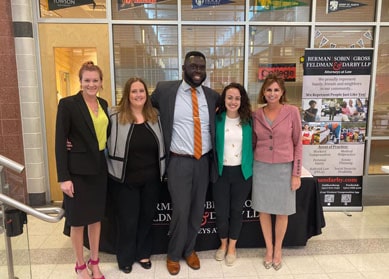
Berman | Sobin | Gross LLP has offices throughout Maryland, including locations serving the Montgomery County area, and our attorneys have represented public employees and government workers in some of the most demanding claims in the state. Our firm’s history of appellate advocacy on behalf of public safety employees, including landmark decisions affecting EMTs, firefighters, and law enforcement, reflects the depth of knowledge we bring to government employee injury claims. One of our founders authored a two-volume treatise that remains the definitive resource on workers’ compensation in Maryland. That foundation extends to the federal employee context, where the legal standards differ but the commitment to thorough representation does not.
We work with clients across Montgomery County and can assist federal workers from Wheaton, Silver Spring, Rockville, Germantown, Bethesda, and surrounding communities. Our attorneys and staff include Spanish-speaking professionals, so language barriers do not stand between clients and the representation they need.
If a Wheaton federal employee injury lawyer is what your situation calls for, the attorneys at Berman | Sobin | Gross LLP are ready to evaluate your claim and give you a direct assessment of where you stand and what your options are. Contact our office to arrange a confidential consultation.