

Waldorf Commercial Driver Injury Attorney
Commercial drivers in Charles County carry enormous responsibility every shift. They share highways like Route 301 and US-5 with passenger vehicles, operate heavy equipment in loading docks and distribution yards, and work schedules that would exhaust most people. When a commercial driver is hurt on the job, the injury is rarely minor and the path to full compensation is rarely straightforward. Berman | Sobin | Gross LLP has spent 35 years representing the working people of Maryland, including the truck drivers and commercial operators who keep goods and services moving through Southern Maryland and the Washington corridor. If you need a Waldorf commercial driver injury attorney, this firm brings the depth of experience and litigation willingness that these cases require.
Why Commercial Driver Injuries in the Waldorf Area Create Complicated Claims
Waldorf sits at a crossroads that generates significant commercial traffic. Route 301 through Charles County connects distribution hubs in Northern Virginia with Baltimore and beyond, and the steady volume of tractor-trailers, delivery vehicles, and specialized freight carriers on that corridor produces a predictable volume of serious accidents and workplace injuries. Commercial drivers working in and around Waldorf may be hauling goods through heavy commuter traffic on Indian Head Highway, navigating the warehouse districts near White Plains, or making delivery runs into Prince George’s County, all of it under time pressure and often under fatigue conditions that federal hours-of-service rules exist precisely to address.
What makes these cases legally complicated is the layered structure of liability that commercial driving creates. A Waldorf-area truck driver who is injured may have a valid workers’ compensation claim against their employer, a third-party negligence claim against another driver who caused a collision, or both. In some situations, equipment failures raise questions about manufacturer liability. In others, a staffing arrangement between a trucking company and a fleet owner means the question of who is actually the legal employer is genuinely disputed. Getting the full picture of what compensation is available requires understanding how these overlapping claims interact, which benefits must be coordinated with which, and whether settling one claim too early forecloses recovery on another.
The Injuries That End Commercial Driving Careers
Commercial drivers do not get hurt in minor ways. The physical demands of the job, combined with the forces involved in heavy vehicle accidents, produce injuries that frequently require extended medical treatment and sometimes result in permanent limitations. Lumbar spine injuries are common among drivers who spend long hours seated and who regularly load or unload freight. Traumatic brain injuries, even those that do not initially appear severe, can affect a driver’s ability to safely operate a commercial vehicle for the rest of their working life. Shoulder and rotator cuff injuries from repetitive coupling and uncoupling of trailers, from climbing in and out of cabs hundreds of times a year, accumulate gradually and then reach a point where continued driving is no longer physically possible.
What makes these injuries particularly consequential from a legal standpoint is that commercial drivers often have their livelihood directly tied to a medical certification. A driver who loses their DOT medical card because of a work-related injury faces not just a temporary disability but a potential career-ending result. The compensation calculation in that situation is different from an ordinary temporary disability case. It needs to account for the realistic vocational picture, including whether retraining to a different occupation is feasible and what wage differential that creates. Berman | Sobin | Gross LLP’s attorneys understand this distinction and bring it directly into how they evaluate and pursue these claims.
Workers’ Compensation for Maryland Commercial Drivers and What It Actually Covers
Maryland’s workers’ compensation system provides injured commercial drivers with medical benefits and wage replacement benefits when they are unable to work. Medical benefits cover treatment that is causally related to the work injury, including surgery, physical therapy, specialist care, and prescription medications. Wage replacement benefits are calculated based on the driver’s average weekly wage, and for commercial drivers who regularly work significant overtime or whose pay includes per-mile bonuses, that calculation matters considerably. An average weekly wage that fails to capture how the driver actually earned their income before the injury will produce an artificially low benefit amount.
Permanent disability benefits become important in cases where an injury leaves lasting limitations. Maryland’s workers’ compensation system uses a rating system to assign a percentage of impairment to the body as a whole or to specific body parts, and that rating drives the benefit calculation. Disputes over impairment ratings are extremely common and often come down to a difference of opinion between the employer’s medical expert and the treating physician. The firm’s attorneys have handled these disputes at the Maryland Workers’ Compensation Commission level and in the courts, and one of the firm’s founders literally wrote the treatise that Maryland practitioners use as the authoritative reference on this system.
When a commercial driver’s injury was caused or contributed to by a third party, such as another driver who caused the collision, a separate civil claim may run alongside the workers’ compensation case. These two tracks must be managed carefully. Settlements in a third-party case can create subrogation obligations back to the workers’ compensation insurer, and the timing and sequencing of both claims affects how much the injured driver ultimately recovers. Getting this coordination right is one of the more technically demanding aspects of commercial driver injury representation.
Questions Commercial Drivers in Charles County Often Ask
I was hurt while driving a route that passed through Virginia. Does Maryland workers’ comp still cover me?
Maryland can assert jurisdiction over a workers’ compensation claim when the employment relationship has sufficient connection to the state, such as when the driver was hired in Maryland or when the employer is based here. Multi-state routes do not automatically strip a Maryland driver of Maryland benefits, but the analysis is fact-specific. An attorney familiar with jurisdictional questions in workers’ compensation can evaluate which state’s law applies and which provides the better benefit structure for your situation.
My employer says I was an independent contractor, not an employee. Can I still file a workers’ comp claim?
The classification your employer uses is not necessarily the classification that controls legally. Maryland applies its own test to determine whether a worker is an employee or an independent contractor for workers’ compensation purposes, and trucking companies frequently misclassify drivers. Courts and the Commission have found employer-employee relationships in situations where the company characterized the arrangement otherwise. Do not assume your employer’s label is the final answer.
The accident happened because my truck had a brake failure. Does that change what I can recover?
It may significantly expand what is available to you. A mechanical failure can support a product liability or negligence claim against a manufacturer, maintenance contractor, or fleet owner separate from your workers’ compensation claim. These third-party claims are not capped the way workers’ comp benefits are and can include compensation for pain and suffering, which workers’ comp does not cover at all.
How long do I have to file a workers’ compensation claim in Maryland?
Maryland law generally requires that a claim be filed within two years of the date of the accident or, for occupational diseases and conditions that develop gradually, within two years of when the claimant knew or should have known the condition was work-related. Missing this window can bar recovery entirely, so it is important not to delay filing even while other aspects of a claim are still being sorted out.
My employer’s insurance company wants me to see their doctor. Do I have to go?
Maryland workers’ compensation law does allow employers and insurers to have an injured worker examined by a physician of their choosing. These examinations are often used to dispute the severity of injuries or to argue for a lower impairment rating. You have the right to your own treating physician, and discrepancies between what your treating doctor says and what the employer’s examiner says are common and are routinely contested before the Commission.
I lost my CDL medical certification because of my injury. Can that loss of career be compensated?
Loss of earning capacity is a component of permanent disability benefits in Maryland, and when a driver cannot return to commercial driving at all, that reality should factor into how the claim is valued and resolved. Vocational rehabilitation benefits may also be available. One of the firm’s appellate victories established that injured workers receiving service-connected disability retirement can also receive vocational rehabilitation services, which reflects the firm’s commitment to pursuing the full scope of what the law allows.
What if I was partially at fault for the accident that injured me?
For workers’ compensation purposes, your own fault generally does not reduce your benefits. Workers’ comp is a no-fault system in Maryland. If there is also a third-party civil claim, Maryland’s contributory negligence rules are more restrictive than most states, which is a significant consideration in how that portion of the case is pursued. Your attorney needs to assess both tracks with the applicable legal standards in mind.
Representing Waldorf-Area Commercial Drivers Takes a Firm Ready to Push Further
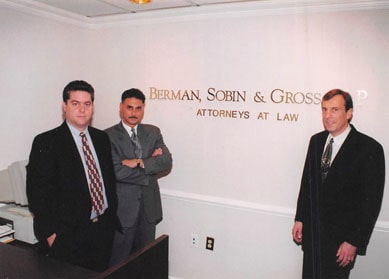
Berman | Sobin | Gross LLP is the largest workers’ compensation law firm in Maryland representing injured workers, with offices throughout the state including locations accessible to Charles County residents. The firm has handled not just thousands of Commission hearings but hundreds of jury trials and appeals before Maryland’s highest courts. When an insurer disputes a legitimate claim or an employer’s classification of a driver is being used to deny benefits, this firm does not stop at an administrative hearing. The attorneys here have shaped Maryland workers’ compensation law through appellate work and legislative advocacy, and they bring that track record directly into how they handle individual cases for commercial drivers throughout the region. If another attorney has turned down your case or told you it is too complicated, that is exactly the kind of case Berman | Sobin | Gross LLP was built to take on. Contact the firm for a confidential case evaluation with an attorney who will stay with you throughout the entirety of your claim, as a Waldorf commercial driver injury lawyer committed to getting you the full compensation Maryland law makes available.