

Dundalk Roofer Injury Attorney
Roofing is one of the most physically demanding and hazardous trades in Maryland. Workers who install, repair, and maintain roofs in Dundalk and the surrounding Baltimore County area face fall risks, heat exposure, structural instability, and tool-related injuries every single shift. When those injuries happen, the workers’ compensation system is supposed to provide a financial lifeline. But the system does not always move smoothly, and roofing employers and their insurers are not neutral parties in that process. Berman | Sobin | Gross LLP has spent 35 years representing Maryland workers in exactly these situations, and a Dundalk roofer injury attorney from our firm can help you understand what you are owed and how to pursue it.
Why Roofing Injuries in Dundalk Produce Some of the Most Contested Workers’ Comp Claims
Roofing work is often performed by small contractors, subcontractors, or crews hired on a project-by-project basis. This creates real complications when an injury occurs. Disputes over employment status are common. A roofing company may attempt to classify an injured worker as an independent contractor rather than an employee, which directly affects eligibility for workers’ compensation benefits under Maryland law. Establishing that the working relationship was an employment relationship, not an independent contractor arrangement, is frequently the first fight in these cases.
Beyond employment status disputes, roofing injuries tend to be severe, which means the dollar amounts in dispute are higher. A fall from a roof in Dundalk’s industrial and residential neighborhoods can result in traumatic brain injuries, spinal fractures, shattered heels, or multiple broken bones. These injuries require extended medical treatment, extended time away from work, and in serious cases, permanent disability accommodations. Insurers pay close attention to high-cost claims, and they often push back through medical examinations, independent medical opinions, or arguments about whether the injury is as disabling as the worker reports.
Workers’ compensation in Maryland also involves a strict notice and filing structure. Missing a reporting deadline or filing incorrectly can give an employer or insurer grounds to contest the entire claim. Roofing workers who are unfamiliar with those procedural requirements sometimes inadvertently weaken their own cases in the weeks immediately following an injury.
The Medical Picture in Serious Roofing Falls and What It Means for Your Claim
A fall from even a modest roof height, such as a single-story residential home, can produce injuries whose full severity is not apparent immediately. Symptoms from spinal injuries, internal trauma, or traumatic brain injuries sometimes develop or worsen over days or weeks. Workers who minimize their pain early on, or who delay seeking treatment because they hope to return to work quickly, often find that an insurer later uses the gap in treatment as evidence that the injury was not serious.
From a workers’ compensation standpoint, documenting the connection between the workplace accident and each specific injury is essential. Maryland law requires a causal link between the work event and the medical condition being claimed. When a worker has any prior history of back problems, joint issues, or other relevant conditions, an insurer’s medical expert may argue that the current condition is pre-existing rather than work-caused. This kind of argument is routinely raised in roofing injury claims, and it requires a prepared legal and medical response.
The attorneys at Berman | Sobin | Gross LLP are experienced in challenging insurer-retained medical opinions. One of the firm’s founders literally wrote the reference treatise on workers’ compensation in Maryland. The firm has handled workers’ compensation claims not only at the Commission level but through jury trials and appeals before Maryland’s highest courts. That depth of experience matters when the medical facts are genuinely contested.
What Roofing Injury Claims in Dundalk Can Cover
Maryland workers’ compensation benefits for a roofer injured on the job are not limited to payment of medical bills. Depending on the nature and severity of the injury, a claim may include temporary total disability benefits if the worker cannot work at all during recovery, temporary partial disability if the worker can perform some but not all duties, and permanent partial or total disability if the injury results in lasting impairment.
Vocational rehabilitation is another benefit that is often overlooked. If a roofer’s injuries prevent a return to roofing work specifically, they may be entitled to vocational services to train for different employment. Berman | Sobin | Gross LLP has experience pursuing this benefit and has been involved in shaping the law around it. In Fikar v. Montgomery County, the firm helped establish that injured workers who are receiving service-connected disability retirement can also receive vocational rehabilitation services, a ruling that expanded access for injured workers across Maryland.
In cases where a third party, not just the employer, contributed to a roofing injury, there may be a separate personal injury claim alongside the workers’ compensation case. A defective ladder, an unsafe scaffolding system supplied by another contractor, or a property owner who ignored known hazards can all create liability outside of workers’ comp. Our firm handles both workers’ compensation and personal injury claims, which matters when these situations overlap.
Questions Dundalk Roofing Workers Ask About Their Claims
I was told I was an independent contractor. Can I still file a workers’ comp claim?
Possibly. Maryland courts look at the actual working relationship, not just the label the employer used. If the employer controlled how, when, and where you worked, provided tools and materials, or structured the work like an employment arrangement, you may be considered an employee for purposes of workers’ compensation regardless of what your paperwork says. This is a fact-intensive question worth having a lawyer review.
My employer says the injury was my fault. Does that bar my claim?
No. Maryland workers’ compensation is a no-fault system. A worker’s own negligence does not disqualify them from receiving benefits, with very narrow exceptions for intentional self-injury or intoxication. An employer telling an injured worker they are responsible for their own accident is not a legal defense to a workers’ comp claim.
The insurer sent me to a doctor who says I can return to work. Do I have to follow that doctor’s opinion?
No. An employer or insurer can require you to attend an independent medical examination, but the opinion from that examination is not automatically binding. You have the right to present your own treating physician’s opinions, and those opinions can be weighed by the Maryland Workers’ Compensation Commission against the insurer’s doctor. These examinations are often scheduled strategically by insurers, and having an attorney involved before you attend one can make a significant difference.
How long do I have to file a workers’ comp claim in Maryland?
Generally, you must notify your employer of the injury within ten days and file a claim with the Maryland Workers’ Compensation Commission within two years of the injury or the date you knew or reasonably should have known the injury was work-related. Missing these windows can seriously harm your ability to recover benefits, which is why early legal consultation is worth pursuing.
Can I be fired for filing a workers’ compensation claim?
Maryland law prohibits retaliation against employees for filing a workers’ compensation claim. If an employer terminates or otherwise penalizes a worker in response to a claim, that creates a separate legal issue. This does not mean termination never happens, but it does mean workers have recourse when it does.
What if I was injured while working on a residential property in Dundalk, not a commercial site?
The type of property you were working on when injured generally does not change your right to workers’ compensation. What matters is whether you were an employee performing work within the scope of your employment. Residential roofing work carries workers’ comp coverage under the same rules as commercial work.
What if my employer did not have workers’ compensation insurance?
Maryland requires most employers to carry workers’ compensation coverage. If your employer failed to obtain it, you may have a claim through the Maryland Uninsured Employers’ Fund, which exists specifically to provide a remedy in this situation. This path has its own procedural requirements, and legal assistance in navigating it is particularly important.
Reach Out to Berman | Sobin | Gross LLP About Your Roofing Injury in Dundalk
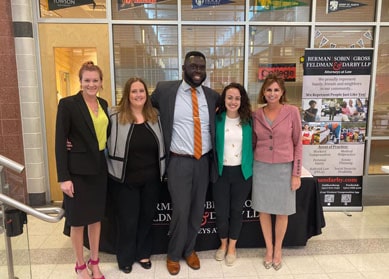
Berman | Sobin | Gross LLP is the largest workers’ compensation law firm in Maryland representing injured workers, with offices in Lutherville, Baltimore, Gaithersburg, and Frederick. The firm has represented workers from across the state in tens of thousands of hearings and hundreds of jury trials, and has shaped Maryland workers’ compensation law through appellate decisions that benefit injured workers statewide. If you were hurt working on a roof in Dundalk and are dealing with a disputed claim, a denied claim, or an injury that left you unable to return to the work you have always done, a Dundalk roofing injury attorney from our firm is ready to evaluate your situation and give you a clear picture of where you stand. Contact Berman | Sobin | Gross LLP for a confidential case analysis.